I do not remember when I first learned that “inspiration” suggested and was derived from the concept of the divine breathing into or through a person. It’s the same root as our word ”spirit,” and “respiration.” Perspiration, too, derives from the idea of breathing, beginning as a kind of euphemism for ”sweat” (which, as a Germanic word, is of course earthy and low). Thomas Edison famously defined genius in these breathy terms, assigning perspiration as “99%” (or maybe just 90%) of its proportion.
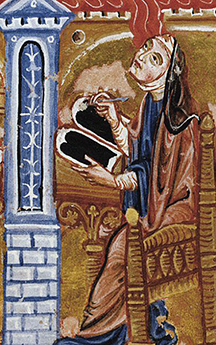
In working with young writers (and reflecting on my own early years as a writer), I’ve been reminded of just how much heavily Edison’s one percent dominates their experience of creative work. If we’re lucky, we get moments when the words or images or music pour into us, perhaps through us, and onto the page. It’s a heady experience, a rush that once worked me through two and a half pencil points in a sunny wood in Eastern Idaho.
When we’re inspired, we’re reluctant to touch what came through us, even if we recognize that inspired work is not universally our best work. Part of learning to be an artist of any sort is cultivating the capacity to work without that impulse, to sit down with a blank page and make things happen even if we’re not “feeling it.” It’s also learning to keep what speaks to us, to cultivate a sustained listening for that divine breath so we recognize it when it whispers rather than roars.
This post, as usual for me these days, is a mishmash of thoughts about teaching, writing, and life. I have now been in the secondary classroom longer than I was in grad school. Somehow, I’m only one year away from having the same number of years under my belt at my “new” school as I did at my “old” one. I’ve become a source of continuity rather than novelty in my program. Even the new course I’m teaching this year is half my old course. Professionally, I am well past any “inspired youth” days of teaching; the struggle is to keep listening for the whispers of inspiration.
The difficulty lies in this: it is almost as easy for me as it is for my students to fall into the tunnel vision of the next deadline, the next project, the next weekend. There are so many hours each week that demand doing. In the tunnel, the air is stale; there’s no lively breath to quicken the soul (or the psyche). Even when the grind is managed, it remains a grind.
Like most of the veteran teachers I know, I totter on the edge of burnout. There are stretches of every year in which the brief respites I steal in segments of weekends do no more than fill the metaphorical emergency tank. I haven’t, this year, hit the acute stress points I have in years past, but the overall level of stress has remained stubbornly high—part of the transition from novelty to continuity is the expectation that you will help hold things together when they threaten to fall apart.
We do what must be done. It’s an obligation, and sometimes a comforting deflection of our responsibilities. We do not because we are inspired, or even out of choice, but because we perceive necessity. There’s no divine breath, only the words it forms…or the words we imagine it forms, and those words are all commands.
Eight years ago, I wrote “We Make Because We Must.” I wasn’t even five years into full-time teaching that summer, and in the thick of my years-long streak of successful NaNoWriMos that I returned to each summer to polish and expand. It’s a different explanation of art than I feel now, or at least a different explanation of artists (though I recognize it as my own). Somewhere between that summer and coming back to this blog, my capacity to listen for the whispers diminished. Writing became habit, sometimes respite, sometimes even expressive, but with few exceptions, it was all perspiration.
More, it was the perspiration of the daily workout, a kind of artistic maintenance that kept skills from atrophying without a particular goal in mind. I’m not sure I agree with Edison in that this is the 99% of genius. It’s qualitatively distinct from the moments where I feel like I am touching something larger, when the words fall “just so.”
I get there sometimes when I’m teaching: the questions get good answers, the jokes all land, and the activity does exactly what it’s supposed to. I enjoy those moments when they happen, but they’re not something I can conjure up, in part because they’re contingent on the students coming along with me, and their lives are enormously rich and complicated (even in their tunnels). Even in teaching, though, those moments are getting quieter, more whisper than roar.
Maybe the quiet is not, in itself, a bad thing?
Art’s purpose is to sober and quiet the mind so that it is in accord with what happens.
— John Cage
John Cage’s String Quartet in Four Parts is one of my favorite pieces of music. It’s one of the last pieces Cage wrote before transitioning fully to various kinds of indeterminacy, yet foreshadows those later works by working through processes that Cage then edited to ensure that any sense of progression was eliminated. The whole quartet is played sans vibrato, occasionally sul ponticello. Sonorities shift around the quartet, and its rare that all four players play simultaneously. Patterns emerge from these shifts, but, as Cage intended, no sense of progress, no dynamic shift through tension toward resolution. The quartet sounds more like an antique than like “new music.” (It’s not a coincidence that the fourth movement of the piece appears on Kronos Quartet’s album Early Music.)
In an alternative version of the quote above (of which there are several; it’s an idea Cage came back to repeatedly in interviews and his writing), it closes not with “in accord with what happens,” but rather with “thus rendering it susceptible to divine influences.” It’s a reversal of the usual sequence of art and inspiration, where it is the former that leads to the latter. Both the quote and the piece came back to me in the midst of working on this post, thinking about quiet and openness and inspiration. (Music will always be part of the mishmash. One of the most fun courses I taught was a community education class on Cage.)
We take breaks to “catch our breath.” Literally, in workouts, to let our heart and respiratory rates get closer to baseline. Figuratively, in life, because we cannot always be doing. The phrase is a curious one, though, in that catching suggests the completion of a chase, or that we’ve snagged something in a trap, or perhaps that something has been thrown our way (like a ball dreaming it is a frisbee). Cage reminds me that only the last of those possibilities nears the truth: what we need, if we’re looking for inspiration, is often to let our breath catch up to us.
That, I think, is among the many things that art can do for us: take us wholly into the moment, and away from doing, away from perspiration. It is something more than rest. And at our best, it can renew for us the experience of inspiration, when creating is as natural as breathing, and just as necessary.

