Doing Better than Distraction

Sometimes, a flood of thoughts is worse for writing than not being able to come up with any. This has been one of those weeks. Even last week’s Nicking from Novels, about a book that I truly enjoyed reading, seemed…trivial. There has been so much happening in the world, so much happening at home. Some of it has just been busy-ness: events, appointments, getting ductwork replaced so the air conditioner conditions all of the house’s air. More of the flood has come from the ugliness of the news. I’ve seen calls for armed revolt just because a politician didn’t get indicted. I’ve seen somebody write “White people can’t speak our mind in this country anymore” in support of a comparison of Black Lives Matter to the Ku Klux Klan.

And all of that leaves out what actually happened: people were killed with bullets and with bombs, in Baton Rouge and Falcon Heights and Dallas and Baghdad. Riot police looking like stormtroopers hauling in women in summer dresses. Protesters throwing rocks and rebar and fireworks at police on I-94. Blood.

People killed people, and our media and our conversations immediately folded them into the narratives of presidential politics and culture war. Instead of “why did this happen?”, we so often frame the question as “whose fault is this?” (The cops’ for being racist, the victims’ for being uncooperative, the protesters’ for inciting violence…)

Look, the world doesn’t need another white dude to hurl a cri de coeur out into the world wide ether. It needs people—it needs us—to engage with one another and with institutions to make change happen.

It needs “how can I help?” to mean more than “how can I help without inconveniencing myself?” I think that’s what it has often meant for me: my answers amounted to “keep being a good person.” That helps! It is better to be a good person than a selfish person, better to practice empathy in our daily lives and try to understand our neighbors. I’ve written about this each of the past two summers. In 2015 it was Paris and Syria and Chicago and Chennai. In 2014 it was Ferguson and Ukraine and Gaza. For too many people, nothing has changed since then.

If we really want things to be better for our fellow humans, we need not just to be good people, but to be better people. We have to work. Listening can be work, but I think a lot of us have listened enough. We need to keep listening, always, but we have to understand that change worth having is change worth making sacrifices for. That can be money for bail funds or time for protests or toner for letters to your representatives or the work to actually run for office yourself. It needs to be voting, too, and trying to understand the local politics that the big media instruments aren’t shouting about.

It means resisting distraction, even when that seems to be the primary mission of the machines through which we route our lives.

Nicking from Novels: Saladin Ahmed’s Throne of the Crescent Moon

This is probably the first time I have picked up a book because the author kept showing up in my Twitter feed. Michigan-based Saladin Ahmed’s debut novel, Throne of the Crescent Moon came out in 2012. He’s an award-winning writer of short stories, with quite a publishing history behind him by the time Throne dropped. He’s also a prolific Tweeter.

Overview

Throne of the Crescent Moon follows an aging ghul hunter, his friends (a magus and an aklhemist), his apprentice (a dervish), and a nomadic girl who turns into a lion. It’s possible (though not entirely fair) to sum up the story in simple fantasy terms: heroes band together to stop an ancient, black-magic wielding evil. The old characters complain about being too old for the job; the teenage characters are bellicose and as naive as they are sincere. The villains, servants of the Traitorous Angel, are wholly depraved and black-hearted; what complexity they have is in their history rather than their motivations.

What makes the novel, well, novel is that it’s not set in the faux-Medieval Europe that forms fantasy’s “default” setting. It is, to pull from Kevin J. Anderson’s back-cover blurb, “a beautiful story of a demon hunter in an Arabian Nights setting.” It also isn’t. More on that below.

The Plot

Adoulla is an aging ghul hunter, the last of his order. He’d like to retire—or to die—but can’t bring himself to do either. He has an apprentice named Raseed, a teenage holy warrior who is fond of quoting scripture. What starts as a normal ghul hunt turns into something more. There are too many of the ghuls for any normal magician to raise. Raseed and Adoulla are saved from being overwhelmed by Zamia, an Angel-touched girl who can turn into a lioness. Her band has been destroyed, body and soul, by the monster that drives the ghuls. She reluctantly joins forces with the learned Adoulla. In consultation with Litaz the alkhemist and her husband Dawoud the magus, the trio endeavours to find the source of the ghuls. They uncover a deeper mystery and get tangled up in the political struggles of Dhamsawaat, where a corrupt Khalif is challenged by the self-styled Falcon Prince.

The Cool Thing to Consider

Let’s talk about “palette swap.” The term comes from video games, where, for example, Sub Zero and Scorpion from Mortal Kombat were the same “ninja” model with different colors. It’s a labor-saving device to create the appearance of novelty. More generally, the concept is used for a simple re-skinning of previous creative work. You take somebody else’s engine and wrap some different skins over the animations, maybe program a few new weapons, and call it a new game. (Consider the endless Candy Crush variations.)

It’s tempting to try and read Throne of the Crescent Moon as a mere palette swap. Adoulla’s a cleric (albeit an irreverent one). Raseed’s a paladin. Zamia’s a shape-shifting barbarian. There’s an evil old necromancer with a monstrous henchman. All the typical elements of Eurocentric fantasy, just painted over with an “Arabian Nights” brush (or put through a filter, if Instagram is more your thing).

Tempting, but wrong.

“Readers yearning for the adventures of Fafhrd and the Gray Mouser will delight in the arrival of Adoulla and Raseed,” Walter Jon Williams writes in another jacket blurb. There are similarities to the Lankhmar books, certainly: inscrutable magics, master swordsmen, an endlessly busy and dusty city. As somebody who enjoyed the Lankhmar books, I appreciate those similarities. (In passing, I’ll mention that it occasionally reminded me of Chabon’s Gentlemen of the Road.)  I also think that the similarities are just one layer. Throne of the Crescent moon is not a palette swap on the old sword and sorcery.

I do like the idea of thinking about different palettes, though. There are ways that Throne reminds me of old comic books, cheaply printed in layers of colored dots. It has a different quality than most contemporary fantasy. And unlike those vintage comics, Ahmed’s colors pop; they’re vibrant. They are not particularly blended.

This isn’t to say that Throne of the Crescent Moon simple or plain. To build a character like Adoulla from swathes of bold, unshaded color is hard. There’s the veneer of the old swords-and-sorcery or swords-and-sandals stories in those bright colors. Throne isn’t a throwback, though, because Ahmed, like those old comic colorists, works wonders with juxtaposition and balance. We can appreciate Adoulla as the type that the palette suggests while understanding his complexity thanks to Ahmed’s skill in balancing the swatches of color.

The setting, too, is created through careful application of color. Dhamsawaat is on the Tiger River. The characters’ monotheism is flavored by Islam, from Raseed’s proverbs to the repressive Humble Students. The myths of the Middle East underpin the magic—for heroes and villains alike. None of these are “painting over” a Eurocentric fantasy setting. Ahmed paints his own setting, in his own colors, on his own terms. Dhamsawaat is not Lankhmar (nor is it Baghdad).

Looked at from a distance, or read quickly, Throne of the Crescent Moon might seem a mere palette swap on pulp fantasy. It’s enjoyable at that level, for sure: the action is compelling, the love at first sight entertainingly troubling to the two young characters who don’t know how to deal with it. Throne rewards deeper attention, though, where we can pick out the individual patches of color that blend at a distance. We see the contrast between Raseed and Zamia’s budding relationship with the long marriage of Litaz and Dawoud (and Adoulla’s long suffering with neither). We see the ambiguities in the choice between a known tyrant and the brilliant braggart who’d usurp him. We see the characters constantly interpreting their environment based on their separate experiences. That’s what makes the novel compelling.

What We Nick from this Novel

Local color is no excuse to be lazy.
It’s always tempting to grab for easy novelty, whether that’s writing in dialect or picking a real place as a “skin” for our concocted settings. That’s a bad palette swap. If we want different color, we need to think about the whole palette, the whole technique of the painting. Taken out of the analogy, we need to consider how our setting, characters and the way we write about them influence our story. Throne of the Crescent Moon works because palette suits the painting; it’s the right way for Ahmed to tell that story. We should aspire to do suit method to message as well as he does.

Believable Beliefs

I don’t care what you believe in, just believe in it.—Shepherd Book, Serenity

I love Serenity. It is not the deepest movie ever made, not the most tightly-plotted, and part of me still can’t get over a world where characters constantly drop phrases in Chinese but there are no characters of Asian descent. Still, it is smart for space opera. (It’s also clever, though that’s a different post.)

While the plot involves human experimentation, conspiracies, and life at the edge of the law, it also hinges on belief. When the movie begins, Mal Reynolds is not a believer—at least he won’t admit to himself that he is one. He tells everybody who will listen that he’s just a captain trying to keep his boat in the sky and his crew fed. (“The wind blows north, I go north.”)

Against that, we have the Operative, a creature of pure belief—his cause is his only moral compass. The Operative is one-dimensional. He’s more a symbol than a character. Especially in the context of a movie, we don’t have to know why he believes as he does. (We might vaguely assume that he’s a product of brain-meddling himself.) What matters is that he is single-minded and implacable. He’s a Terminator of belief.

Mal can’t help but come into conflict with the Operative. The Operative is a legitimate external threat, but he also threatens the story Mal tells about himself, that he is “just a captain.” That internal conflict is nothing new to fans of the series, where the battle between Mal’s pragmatism and his idealism colors most of the jobs the crew takes. In Serenity, though, Mal is eventually forced to believe again, to believe in a way he hasn’t since the Browncoats lost Serenity Valley. Embracing belief leads him to victory: not just a physical victory over the Operative, but actually punching a hole in the Operative’s previously impenetrable faith.

It works because we can see it as redemption. Malcolm Reynolds, who has embraced cynical pragmatism as a bulwark against the war he lost, rediscovers belief to become, for as long as it takes, “properly” heroic (yes, a Big Damn Hero). His beliefs are a logical consequence of his experiences during and after the war. (I assume they follow from his experiences before the war, but we don’t get much of that.) Serenity is thus a story about belief as much as it is about conspiracies and space cannibals.

Not all stories feature belief so close to the surface. As writers, though, we still have to know what our characters believe. Belief is a slippery word. We use it in turn as a synonym for faith, as a synonym for principle, as shorthand for giving credence to. All of those things matter for our characters. Whom do they trust? What are their principles? Where do they put their faith? We need to think about the answers to those questions.

Then we have to follow up: how do we, as writers, challenge our characters’ beliefs? Most internal conflicts can be viewed through the lens of belief. Do we challenge faith with counterfactuals? Do we challenge trust with jealousy? Do we challenge one belief with another? Do we drag them, kicking and screaming, to a point where they have to choose between beliefs? Do we run them into a character whose contrary beliefs are more successful?

We never have to explain to the readers why characters believe the things they do. As writers, though, we have to know. There are differences between a devout middle-aged man who was raised in a faith and a devout middle-aged man who came to faith after trauma. This doesn’t mean that we need exhaustive backstories for every character who crosses our page. Even a thumbnail sketch ought to provide clues necessary to infer beliefs, though.

Chief Inspector Mukul, who is at times an ally and at times an antagonist in Ghosts of the Old City, doesn’t have much of a backstory. I know that he was an officer in the Shehru military before he took over Sakurdrilen’s Watch. I don’t know where he was born, or who his parents are, or even, for sure, whether he has living family. (He probably does.) I know he believes that order is the path to public safety, though, and takes threats to it seriously. The single belief suits his role and colors his personality; it’s sufficient for a background character.

Protagonists and, hopefully, primary antagonists, should have more complicated networks of belief. Their richer internal lives help create the inner conflict that makes us care about them. And that, ultimately, is the reason we connect with stories: whether or not we agree with a character’s decisions, we see how he or she makes them, imagine what we might do in the same situation. That’s how we get characters we can believe in.

Without Mal’s reluctant embrace of belief, Serenity is just another little guys versus authoritarians space story. With some believable beliefs, Firefly and Serenity become something people are still writing, thinking, and cosplaying about years later.

Nicking from Novels: Robert Jackson Bennett’s City of Stairs

Funny story: I first picked up the sequel to local Austin author Robert Jackson Bennett’s City of Stairs, City of Blades. I got about fifty pages into Blades and realized I very much wanted to know the characters and the world better before I read it. The next trip to the library, I picked up City of Stairs. It did not disappoint.

Overview

City of Stairs sits somewhere between “fantasy” and “science fiction.” There are no space ships or aliens. There are guns and cannons and swords, but there are also miracles. One could reasonably describe the miracles as “magic,” but not once in the novel did I ever think “that character is casting a spell.”

Bennett reminds me, in both prose and concept, of China Mieville…only without Mieville’s academicism and bouts of pretension. City of Stairs is a tremendously clever novel that never puffs out its chest to show how clever it is. Behind the plot’s mysteries lie thoughtful considerations of historiography, colonialism, sexuality, and religiosity. There’s also a six-and-a-half foot quasi-viking who bites out somebody’s throat, monsters, and plenty of intrigue. The deeper ideas are all there, but you don’t have to appreciate them to enjoy the book. (Which may be the biggest difference from Mieville.)

The world of Saypur and Bulikov is broken. About 80 years before the novel opens, a Saypuri general kills the Divinities of the Continent (who had been treating Saypur rather like England treated Ireland). When the gods died, their miracles stopped functioning; some of those miracles had touched on the fundaments of reality. For Saypur, which lacked a god, the effects were minimal. In Bulikov, especially, the effects of this “Blink” were disastrous. Since then, Saypur has ruled Bulikov (and the rest of the Continent) as occupiers. The Continentals remain bitter about gods the youngest adults barely know, and about the fact that the Saypuri killed those gods and broke their world.

The Plot

Into this mix of resentment and resignation comes Shara Komayd, intelligence operative and descendant of the Kaj who killed the gods. Saypur’s greatest historian has been murdered in Bulikov. Shara arrives to investigate with Sigrud, her Dreyling “secretary.” (Said secretary writes most of his memos in the blood of his enemies.)  Investigation of the professor’s murder leads indirectly to Shara’s ex, Vohannes Votrov, as well as a group calling themselves “Restorationists.” The Restorationists want to bring back the old ways (and more).

Chaos ensues! There are secret messages, secret warehouses, secrets of families and cultures. The climax is a heady collision of action and metaphysics. The denouement answers some questions, asks others, and leaves things open for sequels. (The second book follows a military officer who is a secondary character in Stairs.)

The Cool Thing to Consider

I’m analytical by inclination and, even moreso, by training. Years and years in school have turned my instincts toward vivisecting what I read, even when I’m reading for pleasure. I remember walking out of Serenity (the Firefly movie) and wondering at how much the movie had sucked me into its world. I had watched the whole thing with trying to spot tricks of narrative (or score, which is what usually gets me).

The setting in City of Stairs worked a similar magic. It’s probably the freshest, most cleanly realized setting I’ve read in years. Jackson Bennett allows the characters to live completely inside the world. He uses epigraphs to provide more background for readers who want it. Shara is a historian as well as a spy, but her explanations fit so tidily into the narrative that they never felt like pure exposition. Select flashbacks fill things in for characters while providing context.

How does the author make it work, though? While one can’t, by definition, imitate the originality, there are things to take away from Jackson Bennett’s methods.

First, language matters. Jackson Bennett names his Saypuri characters and places in quasi-subcontinental style. The names “sound” like they’re from the Indian subcontinent. The Continental names “sound” like a collision of Slavic and Central Asian influence. (The Dreylings are quasi-Nordic, although there’s only the one character in this novel.) Jackson Bennett uses these naming patterns consistently, which helps distinguish the cultures as well as the characters. Bulikov is not an undiscovered part of England, nor is it a jumble of vowels and consonants meant to evoke the fantastic. The language works organically to suggest that the world is bigger than the characters we’re following.

Second, Jackson Bennett makes good use of the “stranger comes to town” element of his story. His protagonist has spent years on the Continent, but not many in Bulikov. She arrives in an emergency situation and is forced to assimilate information at breakneck speed. She travels around the city and meets important people. We’re introduced to people and places through her eyes, helpfully dodging most raw exposition.

Third, and trickiest in relation to the above point, Shara knows more than anybody around her about the world. Part of Saypur’s domination of the Continent relies on the World Regulations, a grand censorship of all mention of the Divine. Shara has studied the Continent and the Divine extensively, with resources only available to Saypuri. She knows more about Bulikov than that city’s citizens do. (It’s terribly unfair, and Jackson Bennett makes that clear.) Shara’s knowledge is still incomplete; she’s still the stranger that comes to town. Her ability to explain so much, but never everything, helps suck the reader in. We want to know what’s next, what’s really going on. It’s the frustration of missing the last few pieces of a puzzle. That lack helps the plot move forward and sucks readers with it through the world and its history in an organic, unforced way.

Strategic use of flashbacks also helps establish the setting. Shara and Vohannes have a history; Bennett uses that history to personalize the broader conflict between Saypur and the Continent. We get a few flashbacks from Sigrud that offer hints of the Dreyling lands, but Bennett keeps things center on Shara. It works better than it ought to because the author is strategic in the use of flashbacks; they always connect to what is occurring in the novel’s current moment.

Last, least, but still important: Bennett gives us epigraphs at the start of every chapter. Many of these are by the murdered historian. Some come from other sources. They’re all in-world texts, though. They shed small light on the events of the chapter and cast relevant shadows on the setting.

What We Nick from this Novel

Characters live somewhere, even when the camera is off.

Good settings give the impression that they exist as more than vehicles for the story. There’s no question that Shara Komayd is the protagonist. She solves the riddles. She defeats the “bad guys,” more or less. The world keeps moving around her, though. We learn enough about Bulikov to infer what its residents are up to after the novel ends (and what they were up to before it began). It works as though it’s a real place, without the author making a show of explaining it. What more can we, as readers or authors, ask of a setting?

Adventures in Taglines

When I started this blog, it was not supposed to be about #postac. I was going to write about writing, all the time. I was going to say profound things. I was going to share my keen insights into the writing process. I was, if nothing else, going to write about the things I was thinking about to try and make sense of them. I had the vague idea that I should have some sort of web presence to point to when people asked about my writing.

That’s what I was doing when I wrote Of Dreams. It was my third post on the blog. It’s still responsible for my highest traffic day. I just re-read the post. It’s raw, and probably the most open I ever was about how much quitting higher education had wrecked me. It was not self-consciously #postac, because I didn’t even know what #postac was. I found out quickly enough. I left academia at roughly the same time Rebecca Schuman was carving out Thesis Hatement and venting her spleen (usually constructively!) on pan kisses kafka.

I was fumbling through on my own with far less attention. I kept writing about writing, but I kept writing #postac stuff, too. It got me traffic. I cared about it. I wanted to document my journey in solidarity with all the people I knew were going through similar struggles. When I went and read other people’s postac writing, I felt less alone. I changed the tagline on the blog to “The Adventures of a Post-ac Writer.” That was back in 2013.

Last week, I went through and checked my links, shuffled a few things around in my sidebar. The virtual housecleaning was necessary—some of the links were broken. Pan kisses kafka is on indefinite hiatus while Dr. Schuman gets her memoir out, continues to write for Slate, and does the whole “parent” thing. Some of the postac sites that had featured my work don’t exist anymore.

I wondered, almost two years ago, whether you can ever really stop being a postac. I wasn’t sure you could, any more than you can stop being from where you grew up. We carry our pasts with us, always.

That doesn’t mean we have to write about them.

I just finished my second year as a full-time classroom teacher. It’s been three years since I was even nominally on the higher-ed job market. I’m much more concerned about preparing my students for college than I am with the preparations necessary to teach college. Really, I wrapped all of my big thoughts into the 4,000 word essay I wrote for “How to Leave Academia.” I still have little ones, and there are occasions where my past and my present overlap in hopefully interesting ways. I’m still going to write about those here. It has felt increasingly wrong to keep the “Adventures of a Post-ac Writer” tagline, though, no matter what it might do for SEO.

My PhD hasn’t expired. I’m still #withaphd. The #withaphd hashtag is great, because it helps erode the “you are your degree” mentality that is so prevalent among academics (and exiting academics). I’m still a writer. But I’m not really a “post-ac writer” anymore. I haven’t been for a while. I’m a writer and teacher who happens to have a PhD.

So, new tagline: Adventures in Wordwork. That label more accurately gets at the mix of writing, reading, and teaching that occupy my time these days, that occupy this blog. Let’s see how it works out.

(P.S. If you are looking for my writings about postac, There’s an annotated list accessible from the menu at the top of the page.)

Nicking from Novels: R.S. Belcher’s The Six-Gun Tarot

R.S. Belcher’s The Six-Gun Tarot is a random library grab. It’s relatively recent, published in 2013. The next book in the Golgotha series, The Shotgun Arcana, is out, with a third book, The Queen of Swords, due out sometime this year. Belcher has a long resume in journalism; he also has an urban fantasy series published by Tor.

Overview

The Six-Gun Tarot is a “Weird West” book. Belcher describes it as “kind of Zane Grey meets H.P. Lovecraft.” That’s not far off, though Lovecraft lacks coyote spirits and mad science. Golgotha, the fictional Nevada town in which the story is set, is a magnet for the weird. Our nominal protagonist, Jim Negrey, arrives in Golgotha with his father’s jade eye. Nearly arrives, anyway. He requires rescuing from the desert by a deputy who’s half capital-C Coyote and a man who’s got an unseemly fascination with dying. Jim soon meets a variety of other characters, including a sheriff who cannot die until a particular day, a Mormon mayor who has to deal with both his sexuality and safeguarding the relics of Joseph Smith, and members of the Chinese Green Ribbon Tong. That list leaves out the Lilith-cult ninja, her daughter, and the story’s villains. And an angel.

So we have, on one hand, standard elements of a Western: a young man with wanted posters out to prove himself, an unflappable sheriff, a Fancy Dan of a mayor, handsome widows and a cagey half-blooded American Indian. On the other, we have two different ancient cults, angels, a great old one, the left eye of (a version of) the creator, Mormon relics, ghosts, and a head in jar. Belcher does a great job of folding the weird into the western. There’s never any sense that you’re bouncing back and forth between sets of tropes.

He also handles a legitimately diverse cast with a deft touch. There are no tokens. There is difference, there is relativism, but it’s never an excuse for lazy storytelling or indecisive characters. Belief matters. Belief inflects reality, particularly when you get into the weird stuff. Belief is not, though, a substitute for morality (nor for reality). The characters bear their own truths, and the author manages to balance them. That is quietly the most impressive thing about this book.

The Plot

As mentioned, Jim Negrey is running from trouble at home. He is the stranger who comes to town. He’s not the only one, though. Two outsiders have recently acquired the deed to the “busted” Argent Mountain Mine. They’ve brought another pair of men with them, and that pair has some sinister plans not only for the mine, but for the world. As characters weave in and out of each other’s orbits, they keep secrets from one another, discover clues, and eventually end up trying to stop the bad guys while the stars fall out of the night sky. The novel’s climax is full of dynamite and magic swords and bloody knives and stubborn ghosts.

The amount of exposition, though, almost kept me from getting to the climax. The hardcover is 360 pages, and nothing happens for the first 120 pages. It’s all introductions and flashbacks and it is not, despite the cover blurb, “a hell of a lot of fun.” Once somebody ends up murdered, the pace picks up considerably. I flew to the end in a few hours.

The Cool Thing to Consider

The Six-Gun Tarot is the closest thing I’ve read in ages to a novel without a proper protagonist. Nominally, it’s Jim. He’s the stranger who comes to town, the one in the first scene and the last. He does a substantial part of the day-saving when the world is ending, and he does it by realizing his father’s legacy. Jim doesn’t take point in any investigations, though, and he rarely knows what’s going on. He’s a good young man who’s done wrong, a kind of apprentice for the role of “unflappable hero.” (I dig unflappable heroes. They’re especially good in Westerns, where I imagine half of them as Clint Eastwood.)

In terms of impact on the plot’s outcome, though, Jon Hightower (the actual sheriff), Mutt (his half-Coyote deputy), Maude (the ninja-woman) or Harry (the Fancy Dan mayor) all have just as much to do. That includes making use of their particular varieties of “weird.” With the exception of Jon, those characters all have well-developed internal conflicts that play out of over the course of the novel, too. It would not take much of a shift for any of those characters to be the protagonist.

That’s also the thing that makes the first third of the novel almost unbearably slow. We jump from character to character with flashback after flashback. The tangents provide plenty of background for the town, but nothing happens. It takes a lot of time and space to introduce these characters and provide their backstories. One set of characters, in particular, seem to exist only to be “civilians” and perhaps to set up the next book in the series (or at least part of it). In terms of density, we’re at the opposite end of the spectrum from Karen Addison’s The Goblin Emperor. That novel is remarkable for the economy of its opening, the speed at which the author kicks the plot into motion. The Six-Gun Tarot plods through introduction after introduction to establish the ensemble; establishing the plot is largely ignored.

Once that ensemble is established and a murder sets plot-wheels spinning, The Six-Gun Tarot positively hums. Belcher balances all of his plates without dropping any. There’s no moment that establishes a Tolkien-ish fellowship. The characters come together organically and act together within the patterns the author has established. There’s more space between the flashbacks, and they mesh better with the present-day plot. None of the characters are sold short during the climax, nor during the denouement. The final two-thirds of the novel were as fun as the blurbs promised, more fun than any of my dad’s traditional Westerns that I read as a kid.

What We Nick from this Novel

Ensembles can be magical, but don’t make the reader wait for them to play.

This novel reminds me of Haydn’s “Farewell” symphony in reverse. Over the course of that work’s final movement, members of the orchestra get up and leave in ones and twos until the stage is empty. Here, Belcher brings his characters out one and two at a time, and he can’t really start developing the material until they’re all there. The novel wouldn’t work without its ensemble, but it almost fails because of its ensemble. A novel without a clear protagonist is such a rarity in genre fiction. That’s due in part to the way that many novels rely on the reader’s sympathy with the protagonist as a hook. Using an ensemble cast, you don’t have that hook. Make sure you come up with a good replacement…or hope that, like Belcher, your characters are interesting enough in themselves to hold a reader until things start to actually happen.

Something Funny

I want to write something funny, something longer than a tweet.

The first novels that I tried to write, back around third grade, were rather shameless and childlike takeoffs on things like Piers Anthony’s Xanth books. (Yes, I was completely oblivious to the innuendo in those books.) I read lots of Robert Asprin, the Myth and Phule’s Company books. Hell, even in high school most of what I wrote was funny, or tried to be and settled for clever. (Or worse.)

That went away, I think, around the time I started writing Serious Poetry. I was, as my students might say, “in my feelings.” I was in love with what I imagined to be profound as only a seventeen year old can be. Yes, there were self-indulgent love poems about crushes I didn’t know what to do with. (No, I’m not posting them.) A lot of the poems I wrote, though, were about the nature of reality, about girls who smoked flowers and rode to improbable places on desk chairs. Some of them were okay. By the end of college, I wasn’t writing many of those. My honors project was a long poem about stories and telling them and chasing them. It was super-serious and I meant every word of it. I still like it.

Meanwhile, I was turning from Anthony and Asprin to R.A. Salvatore (true confessions!) and Tad Williams and various kitchen-sink epics. I had a few fleeting projects along those lines. More importantly, those kinds of fantasy stories were the ones I was reading when I was writing for Imperial Secrets. Hallas and Leor and Dzalin were all serious characters who had various reasons to save, break, or re-make their respective chunks of the world.

By the end of college, I’d turned even further to Brust and Gaiman and Wolfe and Zelazny. Good writers, all. Funny moments in all (even in Wolfe, where they’re always a surprise), but the stories were never hangers for jokes like so many of the books I read when I was a kid.  I “knew” what I wanted to write: thoughtful, clever stories leavened with intermittent one liners. I wanted to put all the thoughtfulness that eventually led me to graduate school behind fantasy stories. (The degree to which it had to go behind the story is another post.) There was not a single whimsical thing in the process.

My kids will both, immediately, tell you that I am the silliest person in the family. They’re not wrong. I pretend all sorts of ridiculous things all the time. The kids are nine and approaching seven and I’m silly enough to make them roll their eyes like teenagers. (My daughter’s head start on that count is frightening.) My students will tell you that I’m funny and weird (and a lot of other things, I expect). Growing up, conversations in my family often revolved clever comebacks (and bad puns). The humor may be pretty dark, but…

…what I’m getting at, or trying to get at, is that it oughtn’t be a stretch for me to write something funny. It is, though. Part of that is the issue of acting versus reacting. One-liners and retorts bounce off of what was said to prompt them; they don’t appear out of nothing. Part of it, too, is that I have spent so much time treating writing as Serious Business. Writing Me is Serious Me, with big thoughts and careful language. Writing has been a way to prove that I’m smart. On the nonfiction side, it’s frequently didactic: here, let me help you understand this thing. (Look, it’s no coincidence that I’ve spent most of my adult life as a teacher of one sort or another.) On the fiction side, most of the stories I want to tell are not particularly funny.

Writing humor is challenging, though. Writing jokes is challenging. Even writing satire—which comes most easily to me—is challenging. It is just as much a skill as being able to explain Bourdieu to your uncle or complex-compound sentences to a disinterested high school freshman. Just as it takes more than speaking well to write well, it takes more than being funny to write funny things. Timing functions so much differently, for one. I know people who can make the stupidest knock-knock joke hilarious because they get the beats just right. Making those beats work in writing takes work, especially when you know that your readers will hear it not in your voice, but in their own inner voice.

How do you get better at things? The same way you get to Carnegie Hall: practice, practice, practice. (My alma mater has a science building named Carnegie Hall; it was a running joke that music students would go practice there just to say they’d played in Carnegie Hall.) Luckily or unluckily for you, my practice space is this blog.

I want to practice, too, because for all the progress humanity has made, there are a lot of bleak things going on. We could all, I think, use something funny…and I don’t do cat videos.

Fate, Fionavar, and Final Notes

You get another dose of Fionavar this week, because I crashed through the final volume in a day and continue to be blown away by it.

Endings are, in my experience, the hardest part of stories to get right. A satisfying ending follows almost automatically from everything that has come before. Some stories end with hand-waving happiness. More leave loose ends—not to be followed up on in later stories, but just dangling. Others may have the right events but the wrong mood. When you don’t get the ending right, it matters, because that’s where people leave the story. I always tell my students, whether writing fiction or essays, to get the beginning and the ending right, because you have to hook the reader and satisfy the reader.

In Fionavar, Guy Gavriel Kay satisfies. He nails the ending when there are, I think, many ways it could have gone wrong. I mentioned in the Nicking from Novels post that The Fionavar Tapestry belongs to “Narnia” type books, with many of its heroes plucked from our contemporary world. Usually, those books end with the characters going home. We get to see how their experiences elsewhere have empowered them for their mundane lives. Without spoiling it, Kay ends Fionavar just before certain characters go home. The characters get to make their decisions in the aftermath of victory and tragedy. We see those decisions. We don’t see how they play out. There’s happiness, but no guarantee of a happily ever after.

More impressive than finding the right moment, the right tone, is that Kay leaves startlingly few loose ends. Throughout the trilogy, Kay weaves together (and I use that phrase intentionally) the threads of so many characters, of so many parallel and overlapping stories. He doesn’t leave any dangling. He tucks them in and ties them off and their ends are, in just about every case, satisfying. (I wish, though, that there had been a sentence or three about Sharra in the last chapter; she alone deserved more of an ending than she got.) The climactic battle and its aftermath allow the stories to play out, to come together and, where needful, again diverge.

Kay does not use the word fate in Fionavar. He doesn’t write, explicitly, about destiny. Yet many of the characters play out stories that have been told before. They are echoes of older selves. Things happen, in many cases, because they “must.” Fionavar as a world, as the first of all the worlds, has its rules. Prices must be paid—and they are, beautifully and terribly. Characters are driven by magic outside their control, by gods who can intervene only when asked and paid in sacrifice. One of the protagonists is a seer, guided by visions.

But there are few prophecies. All the magic, all the visions…they force questions rather than provide answers. It is up to the characters to provide the answers. Their choices are wholly their own. Kay elevates this to a thematic level through inclusion of the Wild Hunt; they are a primal force of chaos that guarantees people can decide. There are patterns. There are rules that bind. But there is always, always choice. (The sociologist in me could create a whole tangential post here on Bourdieu’s model of field and habitus.) The ultimate fate of Fionavar hinges on choice. Two characters in particular, sons of divinity, must choose between the Light and the Dark.

It’s clever and more than a little meta—as with Tolkien, there is in Fionavar a deep backdrop of other stories. Kay leans heavily on Arthurian legend, for one. There is a pattern that Arthur, Lancelot, and Guinevere have enacted countless times. Those characters, and the ones around them, simultaneously understand that they are falling into the patterns of the old stories and, through the actions of others, fighting against them.

In mythology, fighting against Fate never works. Fate is tricky. Fate gets its way in the end. Always. Because Kay uses patterns rather than Fate, though, characters can change it. Characters do, though the cost is great. The closing chapters of Fionavar are full of sacrifice made to change the patterns. As with The Lord of the Rings, the characters of The Fionavar Tapestry act to end an age. They break cycles. They shape the old echoes through sacrifice that will, we expect, create new echoes.

And, as the last notes of the heroes’ actions fade, Kay stops…before the echoes can begin. He sticks the landing without need for appendices, without need to return to Toronto where the trilogy began. It’s representative of the remarkable alchemy of these books: the old stories matter so much, the old patterns shape events at every turn, but it is always the characters who act. It is the characters who decide. With the exception of Gene Wolfe’s Wizard-Knight duology, I don’t think I’ve read a story so beautifully driven both by the characters and the world they occupy. It’s part of what makes The Fionavar Tapestry one of the first things in a long, long time that I expect to re-read.

Contractual Obligations

Back in April, I did something simultaneously trivial and momentous:

I signed a contract renewal.

On the one hand, it was pro forma. I would have had to be terrible at my job to not be invited back. Ninety-nine percent of the staff at my school who want to come back will be there next year. The contract was electronic and I signed it electronically. It was something that I did in under five minutes between my fifth period class ending and the start of my lunch.

On the other hand: Contract. Renewal.

If you haven’t spent time as contingent labor, it might be hard to understand the magic of that phrase. As an adjunct, it’s common to get phone calls on, say, August 10th, asking if you’re available to teach a class starting August 25th (or even August 15th). Sometimes your jobs end unexpectedly after one semester. Everything is precarious. Much—if not most—of the time, you grab at what’s available because you don’t have time to wait for what might be coming. Twenty-seven hundred for a class guaranteed is better than the potential to pick up a $3600 class in a few days. What? You have to drive 35 miles each way to get there? Well, even so. (I once taught a class that was exactly 100 miles away from my apartment. I “needed” it for my CV, so I took it even though after gas and childcare I netted only about $200 for a semester of getting out the door at 5:50 a.m.)

Stability, even more than money, was the reason I got out of the adjunct racket. I have kids. I needed to be able to help plan their lives and activities. That’s hard when you don’t know when or where your next paycheck is coming from. Since “graduating” from the family restaurant at 16, I had worked the same job two years in a row exactly once: the administrative assistantship I had for two years during my masters. Since then, it’s been new classes, new institutions, or both…or the job hunt, for which “stability” is a terrible sign.

Renewing my contract means that I will have the same full-time employment two years in a row. For the first time. Ever. I’ll be teaching most, if not all, of the same classes. I can actually develop curriculum to be used in the same context, rather than having to develop and adapt it simultaneously. I can continue to work on getting better at my job rather than getting used to it.

I do not have to spend the summer looking for jobs, or worrying that I will not find one. I don’t have to do any calculus about whether a cross-town commute will be feasible, or try to figure out how to tailor my resume to different positions. I do not have to wonder what is going when an interviewer asks me about my PhD, or fails to ask about it.

Best of all, it means I get to keep doing a job I still love and still care deeply about, even when my freshman intervention classes won’t let me finish a sentence or my seniors complain about reading 35 pages in a week. I wrote “Smile, you love this job!” on my little calendar white board the day I hung it up in my classroom. My students give me a hard time about it. I don’t care. I can love my job without liking it every minute of every day. And now I know that, for at least another year, I get to keep doing that job.

That April Thursday, we ordered pizza. Partly, that was because Thursdays are the day I run out of steam for cleaning the kitchen and cooking. Mostly, though, it was because I wanted to celebrate. There may come a time when I take signing my contract renewal for granted, when it’s just a thing that happens in April that I have to remember to do, like renewing car insurance. I’m not there yet, though. Even two months later, it still feels good.

Nicking from Novels: Guy Gavriel Kay’s The Fionavar Tapestry

The Fionavar Tapestry consists of Guy Gavriel Kay’s first three published novels (The Summer Tree, The Wandering Fire, and The Darkest Road). Kay is an author I’ve been recommended to read intermittently for years, mostly his later stuff. One of my colleagues in the English department is a big fan of Kay’s work, and refreshed those recommendations this spring. When I finally made it back to the public library in May, I grabbed Fionavar, in part because the library’s collection of Kay’s newer works is a combination of sparse and frequently checked out.
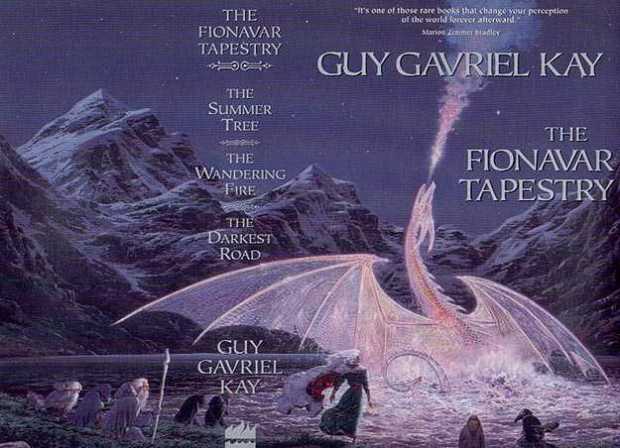
canadafionavaromnibusfull

Overview

The Tapestry books belong to that broad category I call “Narnia Books”—not because they are a thinly-veiled Christian allegory, but because they are the story of contemporary real-world characters plucked from their world into a wholly-discrete fantastic one. (The “wholly discrete” thing is a useful distinction—it makes the Thomas Covenant books “Narnia Books,” but not things like Gaiman’s Neverwhere, which are more about discovering a secret world that overlaps with our own.)

Paul, Kevin, Dave, Kim, and Jennifer are taken by a mage named Loren from Toronto to Fionavar, the “first of all worlds.” It’s a little Amber-ish in category, but Fionavar’s firstness is only ever used to goad certain characters forward. Ostensibly, the Canadians are taken to Fionavar to celebrate the 50th year of a king’s reign. Naturally, fate has different things in store for them.

Many of those things are dark. The alternative version of this post revolved around the idea that “nothing comes without a cost.” People suffer. People die. People suffer worse than death. The whole second book in the series is like the doomed ride of the Rohirrim in Tolkien: stoic bravery in the face of impossibly bad odds. (I’m a sucker for that brand of heroism.) There’s much about fate, and about avoiding fate through sacrifice.

Fionavar is a rich world that borrows its tropes mostly from Celtic mythology. It is solidly built. Kay does good job weaving a story that is intimately tied to his mythology without making the story about the mythology. There are just enough novel idioms (such as “brightly woven” for “well done”) to mark Fionavar as distinct without making it a chore to learn them all.

The Plot

It’s a trilogy. To try to summarize the plot here would certainly spoil at least things from the first book. The broad plot points are standard fantasy fare from the Tolkien playbook: ancient, divine evil must be stopped; artifacts and ancient forces must be properly activated and marshaled; elves get involved. Don’t let that discourage you, though, because as soon as you start to zoom in, the plot points get more interesting. Elements of sacrifice and forgiveness are pervasive. Characters advance the story through sacrifice and error and fierce love.

The Cool Thing to Consider

Kay does something that ought to be impossible: he gets away with telling rather than showing. Constantly, and largely through variations on “impossible.” Despite being, as mentioned above, a sucker for doomed rides and last stands, I teared up all over the place through The Wandering Fire…and mostly at passages like this:

And grieving, grieving, Paul did so. Looking up, he saw Loren’s face distort with wildest hate. He heard the mage cry out then, tapping into his uttermost power, sourced in Matt Sören the Dwarf, channeled through the Whitebranch of Amairgen, and the very heart and soul of Loren Silvercloak were in that cry and in the blast that followed it.

(I could have also picked just about any passage involving horses or dogs. There are many of those to choose from.)

It really shouldn’t work. It’s not quite lampshading, but Kay consistently calls things “impossible,” or “uttermost” or “so deep it could not be named.” This is classic telling—it’s bigger than life simply because I say it’s bigger than life. We get showing, too, rending of garments and swinging of axes and yelling, but so much of Tapestry’s affect relies on the author telling us that things are, basically, indescribable—indescribably sad, indescribably brave, indescribably inspiring.

Kay manages to make this work, I think, through a bit of sleight of hand. I’m sure I’m missing pieces of it, but there are two main ways this telling sidesteps the usual “telling” problems:

First, Kay consistently centers the observation of the indescribable in a character. It’s Paul who, in the passage above, notes all the superlatives. Grounding the “telling” in a character puts it at just enough of a remove as to blunt the force of it. As a bonus, Kay also uses these moment to reinforce characterization.

Second, and far more subtle, is the general pattern of Tapestry’s language. The books draw heavily on mythology (no surprise). More importantly, they are told using elevated, formal language that echoes oral tradition. The word “and” appears frequently; most sentences in any given scene are linked directly to the next. There are plenty of spots one could change the “and” to “and, lo…” While centering the observations in a character blunts the obtrusiveness of the telling, the books’ tone takes the narrative a few steps away from mundane reality.

This combination could flatten everything, limit it to the two dimensions of the titular Tapestry. Instead, Kay is deft enough with his language, his characterization, and his allusions to mythology to elevate the whole story without losing depth. It’s myth-making, it’s world-building, but it’s also (as I commented to my spouse early in the first book) a little bit of a soap opera. The Canadian quintet all have their own hang-ups and backstories. Those contribute to the story’s depth without becoming the story, just as the myth-making contributes to the story without becoming its sole purpose.

It’s worth noting, too, that Kay does not use this telling when it comes to explaining Fionavar itself. The characters do have to explain things or have things explained to them, but that always happens in fragments. They get what they (and we as readers) need in the moment, explained by characters who understand it. There are no recitations of history, though history permeates the novels. Kay sometimes plays around with the timing of events to help achieve this—there are spots in the novel where we are tracking multiple characters simultaneously, where a scene starts at the same moment as a previous one, or halfway through the one that follows. It’s all deftly done, not quite walking a Gene Wolfe-level tight rope, but much better than most “mythic” fantasies.

What We Nick from this Novel

Suit your sins to your style. When you are writing something mythopoeic, you can get away with simply telling us how characters feel, with using superlatives as emotional bludgeons, with starting many, many sentences with ‘and.’ If you are writing noir, you can lean on the occasional cliche. Rules are not meant to be broken, but they do shift depending on what you’re aiming for. As we look at our own work, particularly in the revision process, we need to consider which rules are most important and which ones might not be relevant.