Teaching

Introductions: Windows and Mirrors

I really should have done a new introduction activity for my courses last year…but I reused the first one I’d done at my current campus. Partly, that was a byproduct of the usual beginning of year crush (and a new prep). Partly, I wanted to see what my repeat students would remember about the pictures in it. In any case, I am not running it back for a third year. 

The first day of a class matters, but it is hard to make it matter—there are always the nuts and bolts of the course to get through, expectations and syllabi and all of the additions that result from campus policies and practices. It’s a hard day for the teachers—who will need to serially introduce themselves again and again over the course of a day (or two if they’re on block schedule)—but even moreso for the students, who are bombarded with mostly the same information but are expected to keep track of the differences from class to class. Everybody is keyed up. Everybody is somewhere on the nervous-to-excited spectrum. Everybody is bored

So how does one introduce themself to a room of 30 or 35 bored teenagers? There’s as much calculation involved as in any piece of writing. It’s not much more than an elevator pitch. You have to distill your main points into an intro that’s no only interesting, but communicates in the way you communicate. You have to, in calculated fashion, present as authentic. 

”Authenticity” is, as Tressie McMillan Cottom points out (in an excellent piece about Kamala Harris’s performative tightrope), constructed. We have expectations about what “real” looks like—dozens of small and large things about demeanor, tone, diction. I think back to the George W. Bush years and how much was made of him being a guy people thought they could sit down and have a beer with (despite the power of his family in American politics and the privilege he’d lived and breathed as he ascended to the presidency). I also think about how people decided Obama was ‘awkward’ when he sat down over beers with Cornel West and the police officer who’d tried to arrest him for entering his own home. Different presentations of authenticity, different effects (and affects) and different results.  

Teenagers, even contemporary teens immersed in a world that blurs the line between irony and sincerity, can smell a phony. (Thank you, Holden Caulfield.) Therefore, an introduction must be honest. In my case, I teach advanced classes and work hard to maintain rigor…which I need to be honest about but not dwell on. None of my students want to hear “you’ll have to work hard to pull a 93” on day one. I have high expectations for my students because they deserve those expectations. They deserve to be challenged…and they deserve to be supported as they rise to those challenges. 

That’s one of my balancing acts. I’m not one of those people who radiates such charisma that my students are all instantly won over. Despite my best intentions and years of working on it, I still come across as a little scary to students. Most of them get over it, but the more I can establish in my introduction that supporting students is as much part of my philosophy as challenging them, the more easily I can help them turn the corner toward trusting me, toward believing I’m authentic in my engagements with them and not just talking some talk. 

Writers (and writing teachers) repeat “show, don’t tell” ad nauseam. For good reason! It’s hard to show in an introduction, though, hard to demonstrate authenticity without merely explaining “no, really, I mean this. Please believe me!” The trick of it is patience, understanding that an introduction is only a first impression, vital though it may be. Introductions establish expectations and build the frames in which we understand what happens after (in writing or otherwise). It takes some telling to build a window into who we are and what we believe, a little calculation to understand what will read as real to our audience and to accordingly tilt the window this way or that. If you’ll forgive some further torture of the analogy, they key is in making sure the window is actually open, actually looking into the right room. No curtains. No frosting. No phonies. 

Once More Unto the Breach

This blog was born eleven years ago in a Starbucks that’s now a Dominos…a storefront that’s two blocks away from the school where I teach mostly English and a little music on the side. Tomorrow I head to campus for my tenth year of full time secondary teaching. “Once more unto the breach” and all…

It’s far, far too early for the mindset I dub ‘grim resolve.’ It’s the still the season of unexpected classroom dreams, of the great inbox-filling email machine whirring to life after a few quiescent months. The days are hot, the sunrise still early enough to punctuate the morning walking of the dog. Still, that mood looms on the horizon more urgently than usual. 

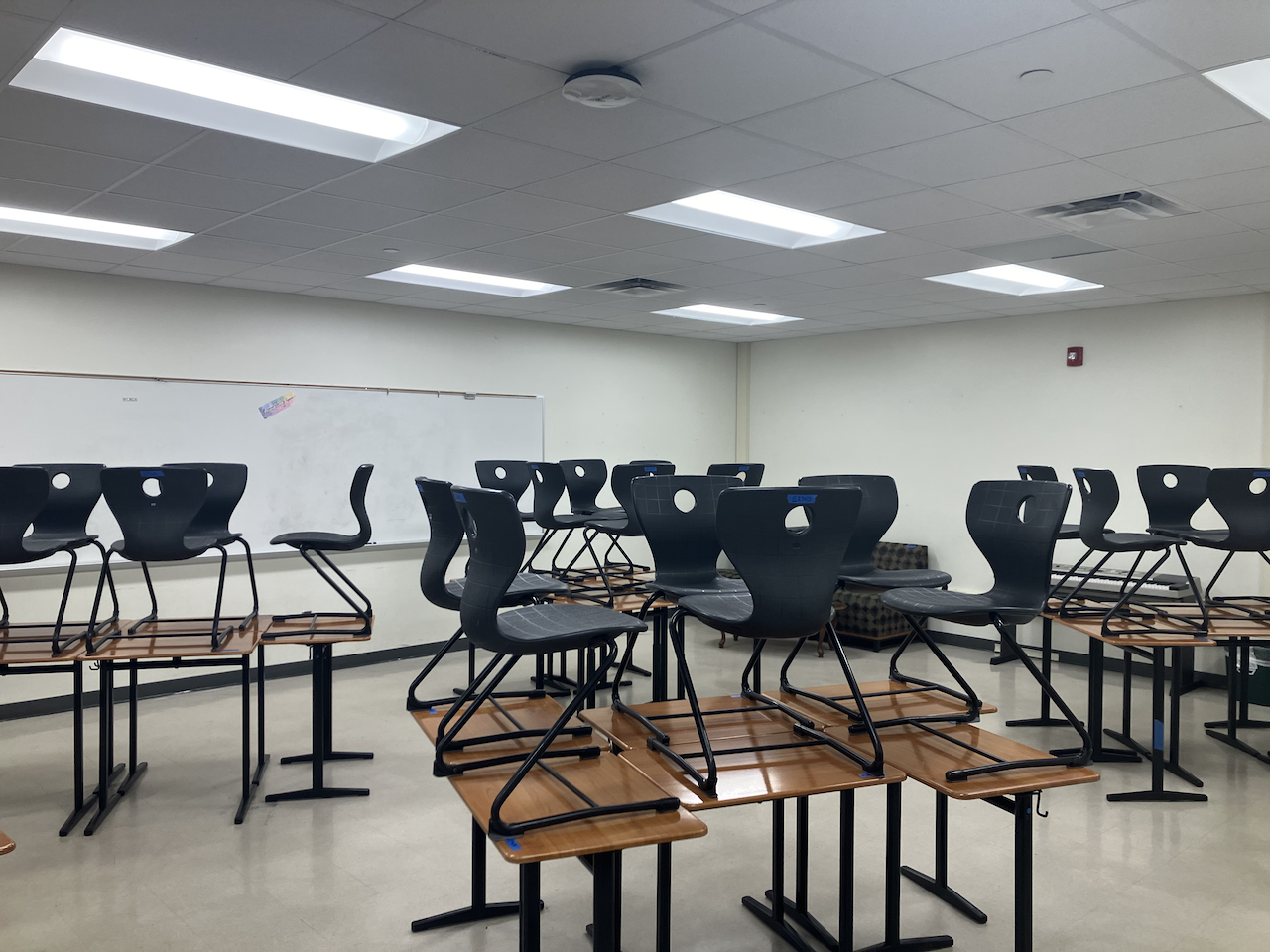
My classroom at the end of the 2023-24 school year. I’m going to need some more desks this year.

The state of Texas has not raised the per-student allotment that is the foundation of our education funding since 2019. As you’re likely aware, there’s been a little bit of inflation since then. Instead of addressing school funding during its regular business, the legislature waited until a special session and considered education funding only in conjunction with Greg Abbott’s school voucher program. The voucher program was not passed; school funding remained unchanged. This resulted in about 80% of the districts in the state facing budget deficits for the 2024-25 school year. 

Education budgets are ultimately balanced on the backs of teachers. Secondary campuses in my district have had their faculty cut by 8-10% this year. Class sizes are up. Teaching loads are up. (I expect to have about 190 students this year.) We will do everything we can for our students, like we always do, but we’re going to be spread that much thinner. Thinking about the numbers, it becomes all too easy to fixate on Henry’s second line: “Or close the wall up with our English dead.” 

Agincourt, the battle in the play and one of the most famous English military victories in history, was also characterized by a numbers imbalance. On the cusp of the new school year, I’m doing my best to focus on the latter half of Henry’s speech:

I see you stand like greyhounds in the slips,
Straining upon the start. The game’s afoot:
Follow your spirit…

(I don’t expect to be crying ‘God for Harry, England, and Saint George’, though.) 

If there’s ever a year I am not straining upon the start like a a greyhound in the slips, I oughtn’t remain in the profession. I’m going to have more students than I should. Some of my colleagues will be dealing with even larger sections and student loads. But I am going to have students. The meetings this week will be interminable. I expect to fill up more than a few margins with my spiral doodles. But the week after? The week after, I’ll have students in my room again. I’ll have found some extra desks and somehow made space for them. I’ll have a new set of welcome activities and a whole lot of names to learn. 

Will I get to “grim resolve”? Absolutely. It might even hit before its usual October arrival. The “resolve” part is just as important as the “grim” part, though. I’m no English yeoman seeking inspiration to show “the mettle of [my] pasture,” nor is “imitat[ing] the action of the tiger” really best practice for teaching literature. Still, sinews may be stiffened, blood may be summoned up. Work will be done, and I can be the active that eschews the passive voice.

And vitally, there’s the other speech from Henry V, the St. Crispin’s Day speech: 

We few, we happy few, we band of brothers;
For he to-day that sheds his blood with me
Shall be my brother; be he ne’er so vile,
This day shall gentle his condition

Leaving aside the class and gender assumptions baked into psyching up a bunch of dudes about to go try and hack other dudes apart, Shakespeare here gives us the bond of hardship shared. I have always had fantastic colleagues. I work with great human beings. Even if we have to hold things together this year with string and duct tape, I know my colleagues will be there to share. We’ll learn some new knots and help each other untie others.

For them, and for my students, I want to be a better teacher. It is easy, a decade in, to relax into mere professionalism. Every day, every month, every year, I do the job I’m contracted to do. That’s even truer when the exigencies of teaching become more acute; I know what I need to do get my students and myself through the barest array of necessary hoops. No muss, no fuss, no problem. Some days, that will be reality. Other days, though? Other days I’ll be reflecting on my practice, trying new things, listening that much harder to the students I went back to the classroom for

With all that in mind, once more unto the breach!

Or, in the more succinct phrasing of Jake ‘Joliet’ Blues: Hit it!

Nobody

“Nobody’s talking about…”
“Nobody’s considering the needs of…”
“Nobody seems to understand that…”

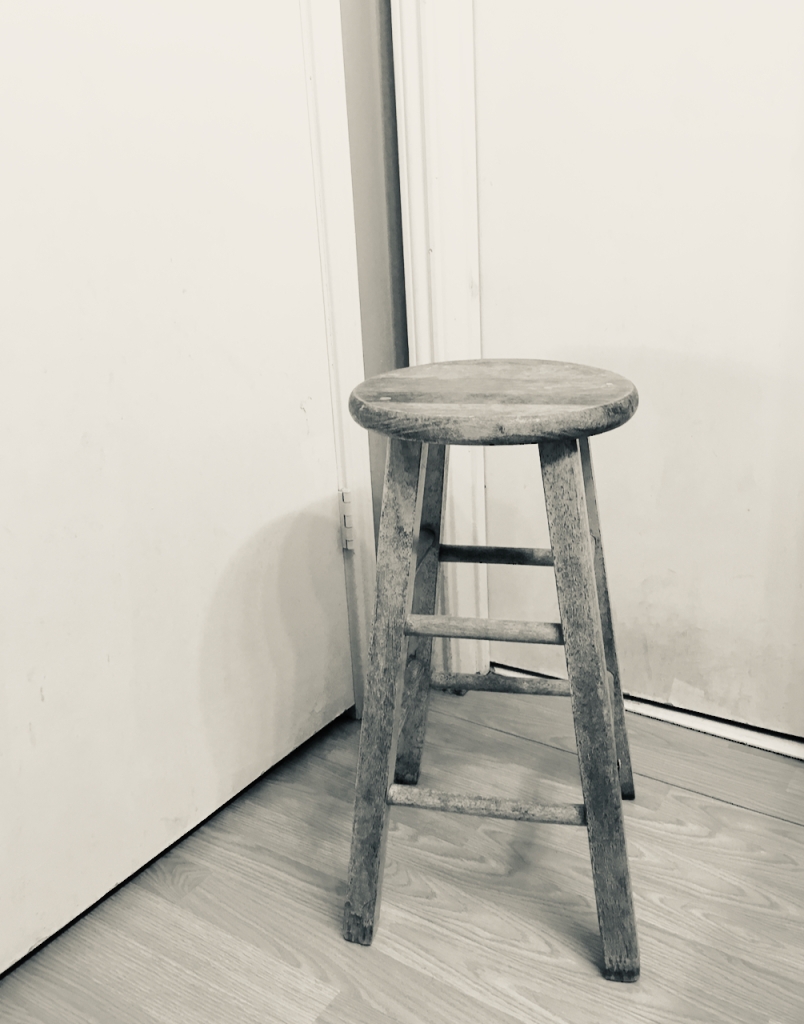
An empty stool in a corner
Who is listening to me?

I’ve been seeing these all week in social media and comments sections. (FSM help me, I cannot look away from this coronavirus in schools train wreck, even though I am definitely inside the train with most of you.) The statements inevitably conclude with something about the speaker’s position. Teachers complain that nobody is thinking about them. Working parents complain that nobody is thinking about them

I can guarantee you, though, that pretty close to every teacher has thought about the parents of their students. I can’t make the same promises about every parent, but I’m guessing many, probably most, have at least a glimmer of sympathy for the position teachers are being put in. (There are always going to be people who have wild misapprehensions about how much work teaching is and how much skill it requires, and yeah, I’ve seen those posts, too.)

The “nobody” you’re looking for? It’s much of our leadership. It’s the machinery of our society. In some cases it’s been willfully blind to problems, in others the blindness has become baked into the system. 

Here are some truths:

People are going to die. Teachers have already died on the job. (See for example this story about summer school teachers in Arizona.) Eventually, students are going to die, too. It’s a “when,” not an “if.”

Having students on campus is not going to magically return education to normal. There will be an awful lot that teachers won’t be able to do in a socially distant classroom. For younger students, especially, it may be more psychologically challenging than remote learning. (Try to put yourselves in the shoes of an eight year old who goes back to school and has to wear a mask and stay in the same seat and not borrow things from their friends and have limited specials and even recess is probably messed up and different.)

Households are going to splinter. Families are juggling irreconcilable obligations at enormous costs in time, money, and stress. There aren’t signs it’s going to end soon. That stress isn’t just going to vanish into the air. That’s ongoing harm that is going to have consequences sooner and later. 

Remote learning is still going to suck, although it will not be the crisis schooling of last spring. Teachers have had time to reflect and prepare. We’ll do better, but there’s only so much our public education resources allow us to level the technological playing field for students (never mind what’s going on with their families).

The truth that’s roiling our collective guts, of course, is the one that I started with: people are going to die.

The truth that’s roiling our collective guts, of course, is the one that I started with: people are going to die. There’s a reason we use the phrase “it’s a matter of life and death” to mean “this is the most important thing.” It’s literal this time. How many deaths are we willing to accept? What is it going to look like when the first school-based outbreak hits the U.S.? Are we going to respond by shutting everything down again? How much are we willing to sacrifice to push that chance of death down as close to zero as we can get it?

Reduced to absurdity, that line of thinking has all of us who are able living in well-supplied bunkers and never going out. Can’t get into a car wreck that way. Can’t get struck by lightning if you’re underground. Can’t catch a disease you’re never exposed to. 

Equally reductive is this idea that we’re going to wave our flags and show off our best mask-free smiles and just try not to keep asking for time off for funerals while everything is going back to normal. (I’m intentionally ignoring both the “it’s in God’s hands” and “it’s all a hoax” camps. Fight me.)

Most people want something between those. We’re pondering, talking about, often shouting about where we think we should be between those two poles. When somebody’s prioritizing different things, it becomes easy to say “nobody thinks about me.” But it misses the point. 

I know we’ve nearly lost it in digressions, but the real point is this: we’re not set up for a public health crisis that’s also an economic crisis that’s also a political crisis. That “nobody is talking about my side” problem is the confluence of all sorts of things in the discourse (yes, I went there. Grad school never completely wears off) that push us towards binary antagonism. 

We don’t have effective mechanisms for keeping people at home and letting them keep their homes (and food and utilities and jobs). That is true even when everything is morning in America: our social safety net is made of twine and pipe cleaners. (And that bolstered unemployment from the CARES act? It’s about to run out.) Our society is predicated on people exchanging their time and labor for money. Think about how many of us identify by our jobs

Our leadership has failed. Not universally. Not completely. To say that this was all avoidable does not return the spilt milk to its bottle. There has been too much magical thinking. There has been too much concern with how the news affects politics. Too many of us have viewed our leaders through the lenses we’ve built up over the years, positive and negative. 

On the education side, we’re asked to be inventive, original, engaging…and meet our testing targets. Bureaucracy cannot help but move slowly. I love my district. My principal is the best boss I’ve had, and every AP has teachers’ backs while also being deeply concerned with the students. And despite that, we don’t know what things will look like in September. We’re not entirely sure what things are going to look like for our scheduled return in a matter of weeks. And why is that? Because we’re dealing with a combination of vague guidance and strict mandates from the state. Because we’re not sure what the county COVID-19 testing numbers are going to look like next week. I am lucky to be in a district that’s grown so much that the buildings are all pretty new, but is small enough that we’re not having to balance poor campuses against wealthier ones as the central office works out policies. And I’m still anxious about the limits of what our district can do. 

And that brings us to the ultimate point here: The “nobody” that’s talking about the things you care about is the same one that’s coming to save you. Nobody. Nobody is coming to save you. Nobody is coming to save us. Whatever combination of panic, frustration, and fury we’re feeling about reopening schools in our coronavirus world is a symptom, not the disease. If we want to change it, we have to try and push our broken systems into a better shape. That’s a matter of consultation and economics and politics…which I hope we are all better understanding are matters of life and death for an awful lot of us. 

Essential

I am supposed to be back on campus, with students in front of me, on August 11. I don’t think you need me to point out that that is less than a month away. I live in Texas, where the state education agency has mandated that all districts offer a full on-campus program (we are allowed to offer remote learning, but not required to). Texas, where our 7-day average for new cases is about 9200 as of July 12. That’s higher than Arizona (though not per capita) and only about 700 behind headline-hogging Florida. 

About ten days ago, the country collectively thought “hey, remember school? We used to send our kids there. We should send them there again.” The president weighed in, as usual, via Twitter and caps lock and his vice president saying the same things but in complete sentences without caps lock. People have opined in op-eds. Most teachers I know and many parents have posted about it on social media. 

“They’re gambling with our lives.”

“They’re asking us to be guinea pigs.”

“They only care about the economy.”

I’ll be reporting back to campus in three weeks. 

I am an essential worker. And do you know where I remember hearing the sentiments above? From other essential workers in March and April.

I am an essential worker. And do you know where I remember hearing the sentiments above? From other essential workers in March and April. In retail. In fast food. In health care when PPE was in shortage (as it is becoming again). Society responded with rounds of applause, with cartoons painting nurses and doctors and grocery store workers and delivery drivers as heroes. 

Then we handed them masks (sometimes, in some states), put up some plexiglass (in some places), and got on with things as best we could. 

No matter what I wish, I do not think that teachers will fare any better. 

We teachers have the idea that we belong to the professional class. By education and by cultural capital, we do. Many states require teachers to have master’s degrees within a certain number of years from beginning in the profession. Every state requires continuing education hours. Teachers spend a lot of time learning. (This is to say nothing of the learning that good teachers constantly undertake in their own classrooms.) 

What this crisis is driving home, what has been obvious for years, is that, in economic terms, teachers belong to the working class. (When was the last time you heard about a lawyer needing a part time job to keep bills paid?) We’re harder to replace than retail employees, sure, but if the choice is between stopping society’s economic machine and grinding up public school employees to keep it running? We’re going into the grinder. “Skilled labor” is still labor. 

…if the choice is between stopping society’s economic machine and grinding up public school employees to keep it running? We’re going into the grinder.

None of this is to say that our worries as teachers are meaningless. Nor is this post about encouraging us all to embrace our inner Marxist. I’ve just been struck by how many teachers’ complaints involve comparison to health care workers (and their salaries) and tacit assumptions that we’re somehow worth more (in some sense) than the essential workers who’ve been doing their essential work for the last four months. 

And our work is essential. The problem I’m seeing in a lot of the conversations about schools reopening is that they mistake how much of teachers’ essential work will actually happen on a socially distant campus. Skilled teaching involves tons of interaction. Even teaching high school seniors, I am generally moving around the classroom most of the period, monitoring students and their work, crouching down by desks to check in, and doing all sort of things that can’t be done effectively from six feet away. And many of those things are the ones that make the much-cited contribution to students’ mental health and security. I can’t imagine trying to teach elementary students from inside a six-foot (or even three-foot) bubble. Your groceries can be rung up from the other side of the plexiglass. Can you learn calculus that way? How much more effective is it going to be than just learning via screen? The best thing about having kids back on campus—and though tragic, it’s not a small thing—may well be that more of their parents will be able to pay rent. 

I have more anxiety than answers. There hasn’t been a waking hour in the last week in which I haven’t thought about how schools will reopen and the idiotically political discourse that’s sprung up around it. The risks are different than they are in retail. My naive hope that we’d be able to glean some lessons from schools reopening in Europe has gone out the window as case numbers have shot back up in Texas and around the country. Those reopenings were all undertaken in places where the spread of COVID had been slowed. The way things are going now, it’s a statistical certainty that students and at least some staff will be showing up to campus with the virus in their system. And schools are just being left to make do.

I’ll control what I can. I’ll get some masks with cool patterns, I guess. I will treat getting home like healthcare workers do: in through the garage, clothes into the wash, shower. I’ll do my job the best I can.

I am, after all, essential.

Learning and Risk and Coronavirus

My classroom, already empty for months, an hour or so before I checked out for the year at the end of May.

Just before the district offices shut down for their usual summer break—one that will be less than half the length it usually is this year—they sent out an internal draft of our plan for returning to school in the “fall” (which in this case means the second week of August). I can’t go into the details for a variety of reasons, but the broad contours resemble the plans and bits of plans that have been floating for the last several weeks: options for parents and students; emphasis on masks, distance, and sanitizing for those students who will be on campus at least part of the time; some preliminary suggestions of how teachers’ responsibilities for face to face and virtual learning might be split up. 

As I mentioned, it’s a draft, and a district level draft, which means much of the implementation still needs to get ironed out at the campus level. (I expect that this will be happening right up to the day school starts.) There’s a sprawl of complications: how will students get to school? How do we deal with students wanting to socialize? And ultimately: how do we minimize risk while maintaining as much educational benefit as possible? 

And ultimately: how do we minimize risk while maintaining as much educational benefit as possible?

It’s that concept of minimizing risk that is the hardest. When many parents were suddenly thrust into managing their children and their children’s “distance learning” back in March, there was, if not an outpouring, at least a wave of expression of sympathy for teachers and how complex our jobs are. Now, especially with the American Academy of Pediatrics encouraging as much education as possible to occur in the classroom, minimizing risk in schools has become another flashpoint in our collective navigation of the pandemic.

I think that you would be hard pressed to find a teacher who would argue that remote learning works best for most students. (There are definitely some, especially in the secondary grades, for whom it does, but they’re a minority.) When we are in the classroom with our students, we are able to read those students and quickly adapt to their needs. You can’t do that with pre-recorded lessons, nor can you do it effectively in an online discussion in which you only see students’ faces. By training and by practice, effective teachers are intensely interactive with their students, even when that interaction means giving them space to figure things out on their own for a bit. 

Assuming that education works best in person, how do we do that? How do we minimize risks? My campus is slated to be over capacity this year while we wait for a new building to open. Managing transition between classes is a crazy problem on its own, never mind what happens inside classrooms. Even if a significant number of students opt for remote lessons, if I am teaching in person sections I can expect to see at least 100 different students every day, possibly up to last year’s 150. (And my load is on the lighter side for a core subject teacher because my AP classes tend to run small.) That brings me into contact not only with those students, but with everybody they have been in contact with: their families, their friends, their coworkers, their customers…to teach in a classroom is to jump back into the deep end of the pool of social contact. How can we even think about risk management in that situation?

We could, as a society, throw resources at it: more buildings, creating outdoor teaching spaces where they are viable, more people employed in education. (This would be a real emergency for “emergency certification.”) That would make more socially distanced classrooms practical, but it gets expensive very, very quickly. It can be disgustingly difficult to get funding for American public education in times of plenty. How are we supposed to throw money at it when the economy is running off the rails and state and local governments are facing major budget shortfalls? Barring a sudden and unexpected groundswell of public agitation for it, I don’t expect we’ll solve this problem with real estate and rapid hiring.

It’s got to be solved somehow, though. Much of the function of our society is predicated on parents being able to put their children in public schools during the day. That’s how we expect people to have jobs and children at the same time. The harder it is for students to be on campus, in classrooms, the harder it is for parents to work. Whom do we make choose between paying rent and educating their child? The families most affected by the quasi-shutdowns of the spring (which were, remember, three quarters of the way through the year and thus “reasonable” to shift toward review and consolidation for the online components) were low income families where the choice had to be paying rent. 

So we try to minimize risk. That puts teachers in the middle of things. We’re being asked to assume risk. I think it’s reasonable to push, as a profession, for that risk to be managed and considered with the best information available. I think it’s reasonable to be scared; COVID-19 is potentially deadly and we’re seeing more and more that not all recoveries are complete. I think we have to keep paying attention to the research, watching our peers in other countries who have already gone back to school, and adjust what we’re doing as necessary.

But we have to do. We can’t eliminate risk.

But we have to do. We can’t eliminate risk. I have a job to do, and I want do it well. I care. That means being in the classroom for the students. Do I dread the first time I have a student in my largely conservative community throw a fit about keeping their mask on? Yes. Absolutely. (The politicization of elementary public health measures has been, despite stiff competition, the most maddening thing for me about 2020.) Do I worry that I might end up with scarred lungs and a lifetime of reduced lung capacity at a time when one party is still trying to allow insurance companies to refuse to cover pre-existing conditions? Yeah. For sure. I also worry about somebody running a red light at one of the bad intersections on my commute and killing us both. There is more to life (and more to risk) than the novel coronavirus.

We had our high school graduation at the beginning of June, at the football stadium with a limited audience in blocked off sections of the stands and all the seats for the graduates six feet apart on the field. The moment the mortarboards went up in the air, all that vanished. The students were all hugs and high fives and treating social distance in ways that would get you kicked out of a middle school dance. Managing risks when your brain is still developing capacity for rational thought is hard.  

I took care of myself that night: I was good about keeping my mask on, and though I hated it, I skipped my usual slow rotation through the crowds to wish my students personal farewells. I went straight out to my car after the ceremony and then home, where I washed my hands for twenty seconds. It had been a good ceremony. There were fireworks, and both the valedictorian’s speech and my principal’s speech were models of taking strong positions without demonizing or excluding people who might disagree. 

The ceremony was worth having. Those speeches were worth hearing. Those mortarboards, so help me, were worth throwing into the air. There are so many ways in which signing up to be a teacher is already signing up to be on the front lines of public health. We’re mandatory reporters for child abuse and neglect. We watch our students wrestle with mental health. Do you need to ask what a bad flu season looks like from the classroom? I’m worried (and none of this has even touched on my worries as a parent)…but the rewards of my job are worth the work to minimize the risk rather than sacrificing even more of our children’s education in an attempt to eliminate it. 

Uncertainty

A few weeks ago, when the world’s crazy was on the horizon but only if you were looking, I had to decide what I wanted to do with Hamlet. I added it to my AP Literature syllabus last year, swapping it in for The Tempest. I make our Shakespeare the last major work we do before the exam. It’s the oldest strata of language the students are responsible for, and it’s good to have that in their “ears” as they get ready for their cold reads. Hamlet, in addition to its place near the heart of the English-language canon, is a really versatile play that works for a variety of potential “Question 3” topics on the exam. (That’s the one question that asks students to deal with a work they read before the exam.)

IMG_0498

Anyway. Last year, I got through the nuts and bolts of the play, focusing on language and performance issues without really building a whole unit around it. (Spring break and high school ultimate season kept a lot of potential elaboration away.) This year, I wanted to give the play its proper due and put it at the center of something substantive. So—and again, this was at a point where even the reports coming out of China were just starting—I decided on “uncertainty.”

Sometimes life can be a little too on-the-nose, yeah?

My district has now officially added two weeks to our scheduled spring break, putting us off campus at least until early April. Like most of you, I’ve been wrestling with what to do, with fears of what may come, with the “pale cast of thought” that “sicklie[s] o’er the native hue of resolution.” So did Hamlet.

That doesn’t mean we’re suddenly all Hamlet—at least no more than we already were troubled Danish princes. The more I think about Hamlet’s uncertainty, the clearer it becomes that he’s phenomenally self-centered, probably the most self-centered protagonist in Shakespeare. Hamlet’s driving questions are all about himself: what should he do, what’s right for him, what’s his place in the universe. Even when he has seemingly committed himself to vengeance and the guidance of the “divinity that shapes our ends,” he’s still thinking about how it affects him.

He does, sometimes, reach for abstract principles of justice and duty, but only intermittently and not always productively. The Act 4 soliloquy he delivers as Fortinbras’ army marches by is generally read as inspired, but it has never quite clicked that way for me. If you haven’t read the play or don’t remember it (buried as it is in a transitional bit where Hamlet’s headed for the ship to England), the gist of it is that all the soldiers marching by, as well as the Poles they’re going to fight, do not hesitate when honor is at stake. They are ready to die for a piece of land that is too small for them to all fight on at the same time. This quickness to violence in defense of honor is what inspires Hamlet to give all his thoughts o’er to vengeance.

It’s a selfish and self-centered uncertainty, Hamlet’s, even when there’s method to his madness.

That’s part of the reason why the play is praised, of course. Hamlet’s easy to read as the “modern” individual, struggling to navigate an unjust world without the pole star of moral certainty. He trusts only Horatio, and Horatio only as a kind of metaphysical sidekick and sounding board for his digressions. Hamlet’s so smart that he doesn’t know what to do. (He’s also pretty consistently a jerk to people over the course of the play.) The questions he wrestles with, as I told my class, are questions we all wrestle with.

But there are limits to what we do as individuals. A melancholy cliffside castle might seem attractive right now (or the Italian countryside of Boccaccio’s Decameron), but that’s not how we live, nor was it how people lived in Elizabethan England. Our uncertainty right now is individual, but it is also painfully collective. We don’t know what is going to happen to us—to our family and friends, to our society, to our economy, to our governments. 2020 was already going to be a messy year. Now there’s a fog thickening over the mess.

Collective uncertainty is easier and harder to deal with. Easier, now, because we have so many ways to communicate that don’t rely on physical proximity. Harder because we don’t have experience. We have experts; hopefully people are paying attention to them. But we haven’t done this before. It’s not influenza in 1918. It’s not SARS or Swine Flu. We are all of us making this up as we go along.

Last Friday, my students wanted answers I couldn’t give them. They’re high school seniors. Their worlds can be as narrow as Hamlet’s, but also as big and sweeping as any of the Romantic or Enlightenment dreamers. They’re already engaging with their communities and the world, but most of them still want to keep a few lifelines to authority. They want to know about prom and graduation and AP exams. They want their rites of passage. A lot of them want to know that, if push comes to shove, the olds will have some answers for them. None of us do. The best I could manage was to remind them that Twitter’s not the best place to get your information, to explain to them the necessity of flattening the curve no matter how cheap plane tickets might be. To remind a room full of 17 and 18-year olds that it’s not necessarily about them, but rather about us.

We’re in this counterintuitive position right now of needing to lean on one another by staying apart. So many things have been cancelled, but people are putting ingenuity and empathy to work to support one another. Virtual concerts and collective education aren’t going to put more masks and ventilators in the hospital, but they can remind us what we’re saving people for. They help us remember that even if we’re stuck in our homes as individuals, we’re all in this together.

(And hopefully none of us, individually, are planning to pass the time with poisoned swords or poisoned wine.)

It’s My Job to Care

I don’t remember much about her. She had moved to Texas from Florida, and had just made the move that I was only starting to think about: from substitute to full-time teacher. I think she had reddish hair. I am sure, though, about what she told me: “You have to love your students.” Nobody had ever told me that before, and I was, at that time, more than a year from taking my first full-time secondary teaching job. The simplicity stuck with me, even though it was a good long while before I had students of my own.

Schools pick up detritus from the waves of “awesome new things” that educational consulting companies market and districts invest in. There’s an inevitable series of trainings, and an inevitable  moment when something changes with district or campus or departmental leadership and a lot of those “awesome new things” get replaced by the newer, more awesome ones. (Really, the vast majority of these programs are simply wrapping fresh jargon around best teaching practices.)

Anyway. One bit of detritus that’s stuck at the high school where I teach is “We will/I will” statements. They’re meant to be a lesson frame: we do these things together, and I (meaning you, the student, who totally owns this statement) will be accountable for this other thing. “We will learn to apply the Pythagorean theorem to solve problems related to area./I will turn in activity 3.11 at the end of class.” It’s a frame that predates my time on the campus, and it kind of bugs me. Contrarian that I am, I’ve reframed them as “our job/your job”—what we’re doing together and what you’re responsible for as an individual. It works pretty well for me, but you’ll notice that it leaves out “my job.”

Teachers do a lot of jobs. I’m not getting back on this blog to talk about the nobility of the profession (though I believe in it), nor about how long-suffering teachers are (there are ups and downs in every job). Students will be back in my classroom in a matter of hours, though, and I want to talk about the most important part of my job: to care.

Last May, I had the chance to see the first group of students I taught graduate from high school. I spent my first year teaching in a public charter in East Austin. There was flailing, there were ups and downs. I might have done more crying than laughing that year, and spent most of it physically and emotionally exhausted. At the end of the year, I was the master of ceremonies for their eighth grade graduation. It’s a small enough school that I had taught English to all of them. Most of those same kids crossed a bigger stage four years later as high school graduates.

IMG_0052There was a different kind of crying.

Among the handshakes and hugs and incredulous exclamations, there were two people I really wanted to find. One was the student who had bribed me into dancing at the school dance by promising to do his homework. (I still have a picture of the two of us from that dance.) I had promised him that I’d come see him graduate, but we hadn’t spoken for years. As an eighth grader, this student was barely hanging on. I worried about him. He told me he was dumb, told me nonchalantly about things in his life that “weren’t that bad” when they obviously were. I was deliriously happy to see him get a diploma. I’ve got another picture of the two of us now—one that he had to take because I was only a month into smartphone ownership and couldn’t work the selfie camera.

The other person was a former colleague. When I was on campus, she taught reading to struggling students. She was also one of the people who helped keep a certain struggling me afloat in and out of the classroom. I wanted to thank her, to let her know I was still teaching. She was on the administrator side of the stage. I explained, in that not-quite-cursory way that you explain things when there are hundreds of people all trying to talk to each other, how much her help and that from my other colleagues had meant to me. I wish I could remember the exact words of her response, but it was something like, “we all knew you cared about your students.”

That meant more to me than anything else she could have said. That year was hard, y’all. I struggled. I was looking for answers on classroom management everywhere and not finding anything that worked for me. The AP who managed discipline had an honest-to-FSM intervention with me and my problem section. (I teared up trying to explain to the students how much I worried about them, which led some of them to make bets about whether I’d cry when I mc’d their eighth grade graduation.) The short version is that the year was hard in large part because I cared. I cared, and I wasn’t that good at the other parts of the job yet.

I’m better at those after a few more years of practice, but still: It’s my job to care. I could put it up on my whiteboard every day. That’s my first responsibility: to care about my students and, when they need it, care for them. Yes, I want them to learn to write a bloody thesis statement. Yes, I want them to be able to speak meaningfully about what they read and to make sure that their language never gets in the way of their ideas. Mostly, though, I have to care.

My department looks a lot different than it did last year. We have a lot of new faculty. For the first time since I arrived on campus, there’s been turnover on my own grade-level team. As I’ve gone through the last week and a half of inservice, I’ve been thinking a lot about what my job is—at least when I catch my breath between rounds of actually trying to do it. I haven’t come up with a better answer than “It’s my job to care.” It’s not the only part of my job, but I’m pretty sure it’s the one that all the rest of teaching builds on.

And tomorrow? Tomorrow I get another 150 people to care about. Even on the inevitable days I will ache for a magic wand to fix their troubles, I think that’s pretty awesome.

Thinking Cap Swap

capsforsale

(Caps for Sale by Esphyr Slobodkina)

The parallel universe in which I hold graduate degrees in English isn’t that far from this one. For some reason, it never occurred to me to not go to graduate school. (I’m not entirely sure why this was, but it’s probably related to the time when somebody called a family reunion asking for Dr. _____________ and it could have been any one of seven people.) The only real question for me was whether I’d do English or music. I’d backed my way into my music major. (Instrumental lesson waivers are a gateway drug.) English seemed like a natural fit. I’d always been good with words. Why didn’t I dance with the one what brung me?

The short answer? I was sick of close reading. It felt less like a particular kind of thinking cap and more like a straitjacket.

I was never quite a traditional English major. My department allowed me to carve out a plan that balanced literature classes and creative writing classes. This allowed me sufficient training in literary theory and good writing that I started hating some of the genre fiction I’d so loved in high school. It never made me fall in love with “literary” writing, though, because so much of the stuff took itself so very, very seriously. It felt pretentious and the way we read it felt even more so. I wanted to read books without having to pick them apart.

I had a student this year who complained bitterly about Jane Eyre. It will be her Tess of the d’Urbervilles—a novel that I read and hated in high school and am still somewhat bitter about. I don’t feel bad about assigning Jane. There are much worse nineteenth-century novels out there in terms of length or difficulty or things to discuss. I also have a responsibility to get students ready for the exam the College Board writes. That exam include plenty of pre-twentieth century works. Jane Eyre had ample pedagogical merit, even if some students hated it.

The student’s seething made me think about that time at the end of my undergrad when I decided that I couldn’t put myself through who knew how many years of picking apart novels. It felt like killing them. Going for an MFA seemed useless, too, because I’d found my creative writing classes almost as bad as the literary ones for pretentiousness. (To be fair, it came mostly from the students. The professors I worked with at Mac, including the fantastic Wang Ping, were great.) I just didn’t want to hate what I read or wrote.

I’ve done a lot of writing since then, and a lot of reading. Some of it I’ve hated even as I was doing it. (Yay! Grad school!) There’s no doubt I’ve done at least my share of pretentious things, probably more. You don’t make a comparative studies omelette without breaking a few common sense eggs, and I still cringe at some of the things I forced into my master’s thesis. (Mikhail Bakhtin and mature Harry Partch go together better in theory than in practice.) I can’t get away from analysis. I tried! I was going to “just” do composition, but I added music history because I missed writing papers.

What I couldn’t understand—couldn’t have understood, really—when I was developing close reading skills as an undergrad (or, as it felt sometimes, having them inflicted upon me) is that it gets better. Getting better at close reading has meant I can pick up important pieces as I go along without having to let the close reading devour the attention that could be aimed at all the other good stuff in the writing.

Small digression: My college roommate was increasingly obsessed with traditional Irish music. He played it in our dorm room as he worked on learning tunes from recordings. At first, I could tell the tunes apart. Then they all started sounding the same to me, because there are a lot of similar patterns across the various jigs and reels. He insisted that when you listened enough, they started sounding different again.

Close reading is kind of like that. When you’re learning it, it can be miserable because every text becomes this series of discrete semiotic fragments—just a bunch of disassembled jigsaw pieces. Combine that with a 170-year-old text, and I’m sympathetic to the student I mentioned earlier literally burning her copy of Jane Eyre when we were done with it. When you have more practice with close reading, you can spot the shapes of the puzzle pieces without losing sight of the image.

…which doesn’t necessarily stop you from having plenty of pretentious things to say about it.

I have a long “want to write” list this summer, and a lot of related chores: reading up on 1848, revisions on existing pieces, blog posts, essays about some of the great novels I’ve read in the last year. Some of those things require my close reading cap. Other things require the “say something clever” cap. Others—most of them, really—require the “shut up and write” cap. The juggling of such hats isn’t easy. It wasn’t something I could do when I was sixteen and busy hating Tess. It wasn’t something I wanted to do when I was picking graduate programs. Now, it’s something I do out of habit as I bounce between the different paths of my wordwork.

Hopefully the monkeys stay away.

Favorites

My first year of teaching, I somehow ended up emceeing eighth grade graduation. I made a rookie mistake when introducing the class valedictorian: I admitted that she was one of my favorites. I knew that teachers aren’t supposed to have favorite students any more than parents are supposed to have favorite children. We do have favorite students, though. We’re human beings, and can’t help it.

What a lot of students don’t get, though, is that there’s not always much correlation between the students who are good at school and the students who are teachers’ favorites. It is definitely easier to get along with students who behave in your class, who get all their work turned in, who are respectful when they have questions. That stuff does matter, but personality matters, too. I’ve been pretty fond of students who think I dislike them. (They think I dislike them because they’re frequently on the wrong side of 70 in my class.) One of my favorites from this year actually ended up completing English IV in credit recovery.

(Please don’t ask me about credit recovery. There will be ranting.)

Graduation was last week. It was my third at this high school. (Almost) all the seniors I had this year for English IV and AP Lit crossed the stage. So did students that I’d had for English intervention, including the student who called me Mister Doctor Coach and a student who, as a sophomore, wrote me a thank you note and said that I was her favorite teacher. In that note, one I think she had to write for JV basketball, she explained that my class was the first time she had had a favorite teacher. Early this year, this student and a friend would swing by my class at the end of the day and hang out with my really small ninth period class.

Crossing the stage at graduation, she cried. She was supposed to smile with the school board member handing her the diploma folder, but she couldn’t quite manage it. I don’t know if she managed the “happy just got my diploma” picture that the venue took of every graduate to sell later. (The diploma folders are empty, by the way. Students have to come get their diplomas from the school the next day.) I do know that, when I finally tracked her down in the happy chaos outside the venue, she was smiling, and I was the choked up one when I told her I still had that card.

I do get choked up. Not for everybody, but for students like this one. Students like the one who faced incredible mental and physical health challenges all year, the one for whom I worried more about survival than graduation. Students like our valedictorian, who is one of the smartest and most humble students I’ve ever taught—and one of those exceptional individuals who has overcome the socioeconomic odds. He’s off to Yale in the fall. And some students I get choked up for for no specific reason at all.

I get choked up because I care. And it’s because I care that it matters so much when students tell me that I’m their favorite teacher or that my class was their favorite or the first time they enjoyed English.

It’s not an ego thing—not exactly. I’m not in competition with my fellow teachers. We don’t collect the nice things students say about us and go down to the lounge and have a competition about who is most loved…no more than we have competitions about who’s said the meanest things to us this year. I’d be happiest if my students liked all of their teachers.

The thing I dig most about hearing I’m somebody’s favorite teacher is that it means I’ve gotten through to them. Whether it was with a stray comment or checking in with them after they’d been out sick or, heaven forbid, some actual bit of class content, I’ve gotten through to the students who say I’m their favorite. There’s a connection there. I made them care, at least a little, about learning something, about dealing with the adults they’re becoming, about responsibility or humor or some part of being human. It also means, most of the time, that the student’s made a connection with me.

Successful teaching is about making those connections. It’s not just about content, which is where administrators and legislators so often go astray as they pine for the fjords of the quantifiable. When a student says I’m a favorite, it means I’ve done my job, no matter what the numbers show. Really, when those connections happen, the numbers get better anyway.

It’s one of the most satisfying things about the end of the year: the students stopping by (in some cases sneaking back in) to say thank you and goodbye and have a good summer. I love it when it happens for me, and I love seeing it when it happens to my colleagues. It’s one of the reasons teaching matters, and one of the reasons I’m happy to go back and do it again next year.

Mister Doctor Coach

I’ve never felt like “Plocher” is a particularly challenging surname to wrap one’s mouth around. As I tell my students, “it rhymes with joker.” (I don’t give the students a hard time about the other pieces of my name or my ridiculously long work e-mail address. Some day, I’ll write about changing my name when I got married, and all the misadventures that come with having two middle names.) Some of my students never quite get it—I hear lots of “Plucker” and “Plotcher” and “Ploh-tcher” deep into the semester.

One student, though, after inadvertently addressing me as “Miss” and mangling my name several times, just called me “Mister Doctor Coach.” It started as fumbling for the right title, but it caught on with him. That’s all he ever called me afterward. He still calls me that when he sees me in the hallway.

I have written a lot about the emotional challenges of leaving the academy, about expectations, about failure. You can find those on my #postac page, or a longer, more reflective single piece in the “works” page. Most of the conversations I’ve had lately with other PhD holders and graduate students, though, have been about the “professional journey.” That’s not something I’ve written about all that much, and certainly not from my current perspective, four years out from my leave-taking.

“Mister Doctor Coach” isn’t a bad summary of where my journey has taken me. These days, I am definitely #withaphd rather than #postac. I am not, technically speaking, “in my field;” my doctorate is musicology (with a minor in comparative studies) rather than English (in which I hold an undergraduate degree). I do what I do because I figured out (after sorting through the narrative wreckage) that my field was teaching all along.

My professional journey has been shaped by the needs of my family. I was lucky enough to get through graduate school without accumulating significant debt because my spouse had a good job with excellent insurance and we still basically lived like grad students. I juggled my work as a gradjunct with being a stay-at-home dad, including taking my son to the numerous therapy appointments that followed his autism diagnosis. (I mentioned that we had really good health insurance, right?) With two kids, one of whom needs more supports than many, the idea of either a) sticking around in the Twin Cities and ramping up my adjunct workload or b) chasing VAPs that would require frequent relocation became…implausible. I decided, when the first round of musicology openings closed, that I wasn’t going to keep, as I put it, “paying Interfolio for lottery tickets.”

Shortly thereafter, my family moved from Minnesota to Texas. My spouse’s family lives mostly in the Austin area, so we had some nuts-and-bolts support. We were also, though, broke. It took my spouse longer than expected to find a job. I interviewed for a few entry-level positions outside academia, and applied for many, many more.

None of those panned out. The interviews I had seemed to be decided in the first few minutes when I failed to convince potential employers that my doctorate didn’t make me a flight risk. Several straight out asked if I would be going back to the higher ed world, and seemed skeptical when I demurred. These were entry-level positions, mind, mostly in writing-related fields.

Sending out applications doesn’t pay the rent, and rent in the Austin area is…high. I needed something that I could do, even part-time, that would generate some income while I looked for my imagined perfect job. Requirements for substitute teaching? Some college education? I had lots of college education. I spent a half-day at orientation, had my fingerprints taken and background checked, then started finding my way around Austin ISD one school at a time.

For months, I’d sub three to five days a week and spend the other days filling out applications. I wasn’t happy, but I’d also helped get the household to a point where we didn’t have to take on credit card debt to meet basic living expenses. By the spring, I was getting long-term substitute jobs that paid better (marginally, but it mattered) and gave me the opportunity to do actual teaching. (Short sub jobs were pretty much always some combination of babysitting and riot control.) I remembered that teaching was a big part of why I had gone to graduate school in the first place.

Texas, for better or worse, has a robust alternative certification path into the teaching profession. I took it. The classes were the expected mix of useful and redundant. My year spent as a substitute gave me more than enough classroom time to get my probationary certification. Which brought me back to…interviews.

This time around, I was interviewing for jobs with a certification in hand, a full year of subbing (including those precious long term assignments) and years of teaching in college. The first question was still “you have a doctorate, why on Earth do you want to teach middle schoolers?” Because of the certification timelines, I was interviewing during the late summer rush. (Teachers have until mid-summer to opt out of their contracts without penalty. This means that when administrators come back from July vacations, they have only a few weeks to fill newly-vacant positions.) Some of the interviews were really rushed. In the worst, the principal announced that we had 10 minutes for the interview, mispronounced my name, didn’t even try to apologize, and seemed most interested in how much of a disciplinarian I could be. The interview only made it about six of the allotted 10 minutes, and my “thanks for the interview” note included a polite refusal to be further considered.

I eventually landed a job at a charter school in East Austin three weeks after the school year started. Most of my meetings with the principal included admonitions that teaching middle school was not like teaching college. It isn’t, and I knew that, and my lessons were planned for the eighth graders I was teaching. I was a first year teacher, and neither the lesson plans nor my putting them into practice were perfect, but I left most meetings with my principal furious at the repeated idea that I couldn’t tell the difference between a thirteen-year-old and a 20-year-old. I did have great co-workers and assistant principals from whom I learned enormous amounts. They weren’t quite enough to keep me there.

I felt bad about leaving that job because it felt like I was abandoning kids who’d already been abandoned or neglected by too many people. The commute was costing me, though—two hours a day spent sitting in Austin traffic, barely moving. The hours and the stress made it harder for me to do my job and harder to do the right things at home. It was not sustainable. I let the school know that I wouldn’t be returning and went through another summer of applications and interviews.

With more distance from graduate school and proof that I could last at least a year in a secondary school gig, most of the interviews went better. I still had to deal with some degree skepticism, but it mostly had to do with why I was teaching English when my graduate work was in music. (I got pretty good at explaining that, as much as I’d been a band nerd and sung in choirs, I’d never had any interest in being a band or choir director.) Importantly, I was also better able to explain how the variety of teaching I’d done, including teaching at the college level, contributed to the success of my students.

By the end of the summer, I had landed a job at my current school, where I’ve taken over the AP literature class in addition to teaching various on-level and intervention courses. I coach the ultimate frisbee team. Most of the AP students call me “Dr. Plocher.” In the on-level and intervention classes, I get a lot more “mister” (with or without the Plocher). Some of my ultimate players call me “coach” in class. I’m usually not picky about it. (Teachers, like everybody else who works with other people, choose their battles.)   

My higher education experience improves my teaching in a few obvious ways: especially with high school seniors (and most especially with the AP students), I can set realistic expectations for college. I try to teach my students that professors care in direct proportion to the amount that their students care. Many of my students will be first-generation college students. I do my damnedest to help them advocate for themselves, to get them used to the idea of asking for help when they need it.

From a practical standpoint, the skills I picked up in graduate school are invaluable for nuts-and-bolts teaching. I’ve always been a fast reader; graduate school forced me to refine my analytical chops to keep pace. I can do background research quickly. After having to teach syllabi that were handed to me three days before I started an adjunct job, I do okay with shifting administrative priorities and requirements. (I confess I still complain loudly about them, though.)

There are moments—not many—that I look around and wonder “what am I doing here with my musicology PhD”? The money’s not great, but it is much more than I made as an adjunct. I also know where I’m working from semester to semester, which is something you can really only appreciate if you’ve been in situations where you don’t. I get to collaborate (and hang out with!) some great colleagues without having to compete with them for funding.

I’m doing work that is necessary and important. Sometimes it’s thankless, but not always. The gratification is mostly deferred—another thing graduate school taught me to deal with. Teaching is a different job every day; frequently it’s a different job from period to period, even with the same lesson plan. It will wear you out and lift you up and you will feel your students’ departure at the end of the day…the end of the year…graduation just as keenly as they do, although for different reasons.

This, all of this, is why I secretly like the ridiculousness of “Mister Doctor Coach.” All of those titles are part of how I got to where I am. It’s almost August, and my dreams (as they seem to do at this time of year) are filled with the classroom again. The school year is just around the corner, and I’m looking forward to it…which isn’t something I could say four years ago.