Author: JDJPlocher

Editing and Choice

Editing is selection. It’s choosing what stays and what goes, what can only stay if it changes, and which things are connected. Editing is not just sandpaper or scalpel, applied to remove the bad. Sometimes editing is a rubber mallet to bang out dents (or selectively add them). Sometimes it’s a wrench to tighten loose bolts. Sometimes, of course, it’s a blowtorch.

As I work over my NaNo material, I’m doing a little of all of those things, even though this is just a pre-edit intended to help me figure out what’s missing. (I probably need another 20-30,000 words for the novel to be complete.) I’ve run into some ugly knots—one with timelines occurs quite early—and a plethora of minor things that I’ve nudged about. There are some that I still need to decide on, too: capitalization of some things and just what the hell the monetary system looks like (I’ve referred to six or seven denominations of coins). ’Tis the season, even if it is not national editing month just yet.

It’s also a season for more abstract editorial projects. Whether it’s a Christmas letter or answering a well-meaning inquisitor at a holiday party, we select the bits of our lives that we feel are the best or the most relevant or sometimes just the least worst. We consider most of the same things we do when we edit our writing (fiction or non-): What’s our audience? What do they want to hear? How far should we bend things to fit into a pleasing shape? What might “sell,” and how interested are we in providing it? The break between calendar years is an opportunity for even more abstract “editing.” What are New Year’s resolutions if not attempts to edit the fabric of our lives? We want to keep the good and remove the bad. Carrying that out can be as rough as earnestly digging into our own work.

Editing is the way we put our best selves forward. I try to remind myself of that as I edit. When I have them, I remind my students of the same thing. Too often—and especially when we work on our own material—we reduce editing to mere proofreading. We want to catch our typos and mend our inconsistencies. Maybe we go a small step further and remove some passages that don’t work. If it’s a NaNo project, we might be more comfortable tossing the junk we piled up chasing wordcounts, but not necessarily. There are ready aphorisms about lightning and lightning bugs, about killing our darlings…but really, I think that good editing aims at the questions I cast as abstractions a paragraph ago. It’s up to the person wearing the writer’s hat to provide the final answers, but the editor ought to be asking those big questions. (That’s one of the reasons that finding somebody else to share the editor’s hat is so useful. They don’t think they already know the answers.)

Editing is a chance for us to really engage with a work, to figure out what makes it tick. That’s the challenge but also the thrill of it. It’s taking something cool (hopefully) and making it better. It’s using every tool in our kit to make our best choices. The consequences might not be as dire as picking the wrong cup in a Grail Knight’s challenge, but still, choose wisely.

A Year After Horns and Horses

December 7. Pearl Harbor Day. In 2012, it was also the first day since September when I could get all of my dissertation committee into the same room so I could defend.

That morning, I posted this clip to Facebook:

There were a lot of reasons to pick it. First and foremost, I’m a geek. I grew up on this stuff. When I got older I became a bit of a geek about language, too, and developed an enthusiasm for Anglo-Saxon alliterative verse. When I am psyching myself up for a challenge, Theoden’s speeches (this and the one from Helm’s Deep) are part of my repertoire (along with the “March to the Scaffold” from Berlioz’s Symphonie Fantastique and the James Bond theme). As done in the movie, the scene has just about everything you could ask for: an excellent little speech, delivered well; the right hits in the score with horns and the Rohirrim theme; dramatic lighting; panoramic shots of the whole battlefield to give a sense of scope. The score cuts out at the right moment and sneaks back in wonderfully.

In hindsight, this was a terrible choice. The Rohirrim fully expect to die on their charge. You do not get quite as much sense of it in the movie, but those guys on horses are outnumbered more than 5-to-1. The bad guys have war elephants and Nazgûl. The Rohirrim end up losing their king, and would surely have lost their whole paltry army if Aragorn hadn’t shown up with Rangers and (in the movie) ghosts. I wasn’t thinking about any of that. I was just psyching myself up and killing time on a day I’d spent years preparing for. Posting a video, like making cookies for the public portion of the defense, was a nice diversion.

Were I having a glass half-empty day, I could easily push the comparison with the Rohirrim’s charge further. The horde of orcs could be, say, the job market. The gloomy bravado of Theoden could easily be any grad student’s conviction that the market might be bad, but we can take arms against the sea of troubles. There aren’t any Rangers of the North coming to save us. Und so weiter.

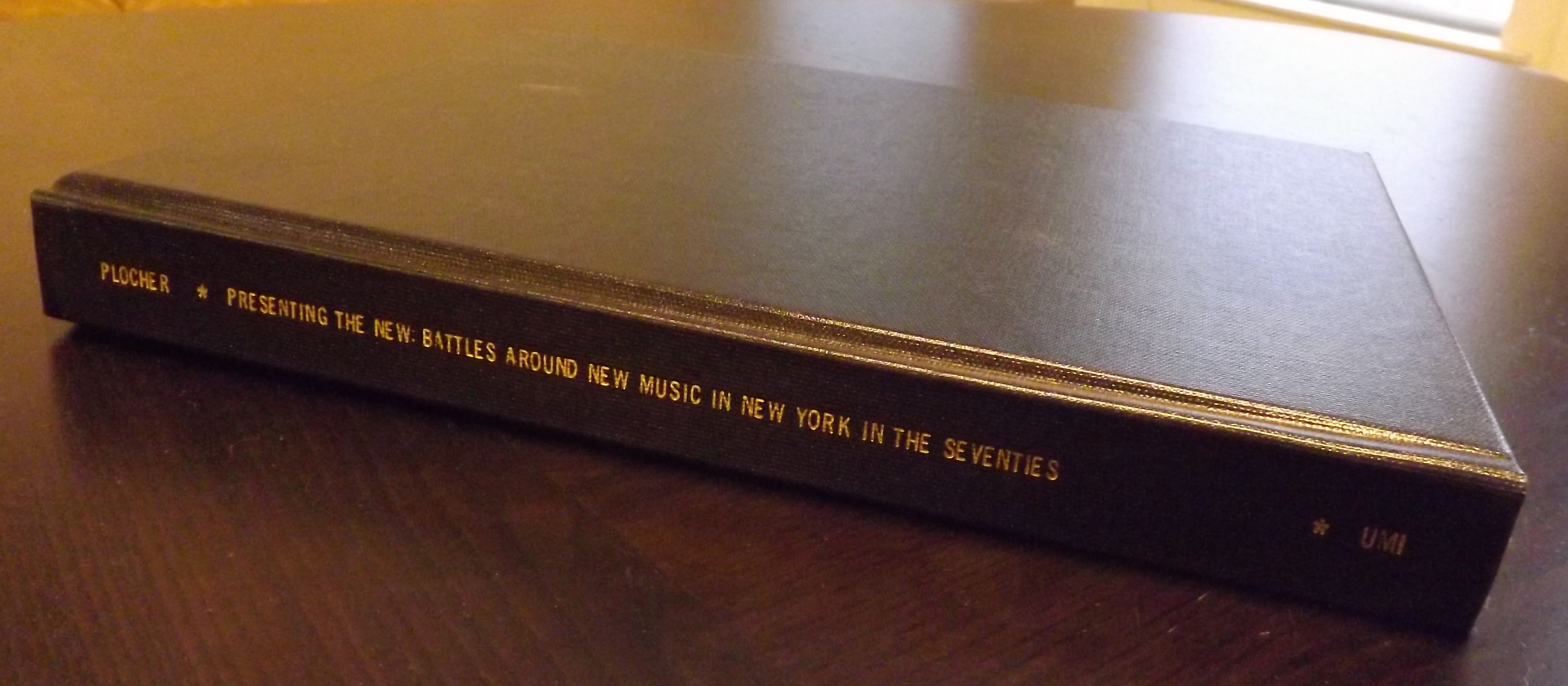
Even if the doom and gloom are true, I don’t want to spend more time on them today. It has been a year since I defended my dissertation, and nearly that since I completed the final round of edits and submitted it, eventually resulting in this:

Bound Copy of the Dissertation

408 pages, appendices included

The past year has been the most unsettled one of my life. I’ve been up and down. I’ve applied for jobs, not gotten them, dramatically switched up the kinds of jobs I’m applying for, and not gotten those either (yet). My family moved 1200 miles from a place where the temperature hasn’t gotten above 0 degrees Fahrenheit for a few days to a place where people are freaking out because it’s 25. For nearly half of the year, there hasn’t been a “normal.” There has been so much waiting, so much anticipation and hope and sometimes hopelessness.

It isn’t all better, but a year out, I feel like I’ve got better perspective on both that video clip and that UMI-bound black book. Defending my dissertation was not a life and death conflict. (If there was one of those, it came after, and there was nothing so tangible as orcs to fight.) Literature is not feeding me poetic lines to spout at neat points in a structured narrative, nor is Hollywood supplying a dramatic score to remind me what I should feel at important moments. I wrote a book. It has some good bits and some bad bits, with enough insights to convince a collection of professors of my worthiness to share a rank with them. That’s cool. It hasn’t made the last year any better. That’s also cool.

Now, anyway. I don’t think I was cool with that six months ago. I certainly wasn’t cool with it ten months ago, when the cold and dark of northern winter were far too apt a metaphor for my life.

We often overplay the importance of finishing things. We wrap stories around our lives because we hope to make sense of them. We want the happily ever after, or the brilliant last stand that proves to be the tide-turning sacrifice. If we carve our lives into a series, we want each volume to come to a tidy caesura. Defending a dissertation could have been one of those caesuras. I could have my victory, walk across campus to turn in my paperwork in wonderfully picturesque snow, and then…we skip to the next book, where I am busily occupied with whatever the author wants me to be doing when she throws the next plot arc at me.

In life we cannot—to steal a line from Elmore Leonard—leave out the parts people skip. I have had a year I wouldn’t mind skipping (or at least reducing to a kick-ass training montage). I still get to cook dinner and do laundry and write blog posts. I’ve got a good chunk of a novel that I am working on turning into something the non-rhetorical you can read. I just watched my daughter just fall asleep on the couch with a book in her lap.

What have I learned, a year out from my personal Pelennor Fields? That the parts that people skip are not always bad, even if they don’t come with horns, horses and dramatic speeches.

NaNoWriMo vs. Dissertation

Round One! Fight!

Hello, December. Is it safe to come out yet?

November’s comparative blog quiet is owed to National Novel Writing Month (secondary sponsor: the passive voice). I spent the month writing (part of) a novel. I dutifully scraped together my 50,000 words despite having a conference paper to write and present, the holiday, and a rather ugly spat of job applications and rejections. NaNoWriMo.org gave me this fancy image as an award:
My winner's banner. Nifty or tacky?

My winner’s banner. Nifty or tacky?

When I validated my novel, I couldn’t help comparing the certificate (there’s a certificate, too, that you can print out) with one I earned at about this time last year: the one that says ‘doctor of philosophy’ on it. The NaNo certificate is much more lively. The thought seemed worth developing, though. I present here a hasty compare-and-contrast of salient features of writing a dissertation and undertaking National Novel Writing Month. (Not included: the effects of either on my future employment.)

Coffee

Caffeine is life for writers. I was surprised at how many of my co-NaNos preferred various kinds of soda or tea to coffee, though. I drank coffee more regularly in November than I had for…since I finished my dissertation, actually. One of my more vivid memories of my defense is that problems with the A/V setup took so long to resolve that my coffee was cold by the time I was able to start.

I also realized that I get more out of coffee than just caffeine. When I’m writing, really writing, I still need the brief pauses afforded by sipping a hot beverage. (Maybe that is why my characters spent so much time with tea or coffee at hand.)

“The only good dissertation is a done dissertation.”

As I mentioned many posts ago, I hit a turning point on my dissertation when I stopped worrying about obsessing with my research and instead chose to obsess with getting finished. It was a grander-scale version of the process most of us have gone through with a paper. You come up with something that is at least a little interesting, you gin up some ideas, do some research…and then you realize you have to submit the paper twelve hours from now, that it’s supposed to be 25 pages, and why did you think you would get any sleep anyway?

At some point in the dissertation process, your thoughts turn away from ‘what is best for this project as I envision it’ to ‘what will my committee sign off on.’ Some people hit that point earlier than others, but I think everybody who finishes reaches it. You tell yourself “I’ll fix that when I do the monograph” or “It’s not worth fighting committee member X over this any more” or “I really ought to research this properly, but I can get by with throwing the right citations into a footnote.”

NaNo is different, because it starts with this ethos. The goal is to get 50,000 words by hook or by crook. The writing coaches repeatedly advise you to keep your fingers away from your backspace key. You are supposed to keep everything, even if it’s bad. (One of my favorite write-in moments was “now we’re going to do an 11-minute sprint of total crap. The crappiest crap you can crap.”) Get the words on the screen. You can edit later.

And damn but some people get words on the screen. 1200 words in a fifteen-minute sprint. 150,000 words in a month. Who knows how much of it is crap? Who knows how much of it anybody else will ever see? Some people clearly write streams-of-consciousness. Others are just that fast. Just as some people struggle to get halfway, others write whatever they please.

The ethos of “wordcount first, everything else is just details” was one of the few things about the month that bugged me. Yes, there is a tremendous freedom in allowing yourself to just write. It is useful to shove your inner editor in a closet. Words in your head never mean as much to your work as words on the page. The obsession with wordcount, though, puts somebody who churns out 70,000 words of 90% crap ahead of somebody who grinds out 35,000 words that are only 40% crap. (See the next point, though—both of those writers will be cheered equally by their fellows.) Others rationalize heftier wordcounts by including blog posts, brainstorming, forum role-play, and anything else that involves typing. NaNo is a competition only to the extent that you’re competing with yourself, but sometimes the whole wordcount thing seemed too easily gamed to me. It is a structural element of the project. It still rubs me wrong…even though 50,000 words is such a usefully concrete goal.

A Community of Fellow Striver-Sufferers

Academia is competitive. Resources are too scarce for it to be otherwise, even though scholars rely on each others’ work. When you write a dissertation, you want it to stand out from—or at least stand comfortably among—the work of your peers and predecessors. At the same time, your fellow graduate students are usually the only ones who understand what you’re going through. They’re also likely to be most of your social group. With my cohort, at least, we all honestly wanted each other to succeed. That got murkier when we started gunning for the same jobs, but few things unite a community like suffering. The community developed organically. Anybody who passed their first semester and remained gung ho about the whole graduate school experience got funny looks. We traded in commiseration, and still do when we get together at conferences.

NaNo is not competitive. At all. The closest thing to competition comes during sprints or word wars. Having the highest wordcount for a sprint might get you a piece of chocolate or some amiably jealous congratulations. That’s it. Everybody cheers for everybody. Gung ho attitudes are pervasive. As much as the participants love writing, NaNo seems to me as much about the social activity as the work itself. I feel comfortable putting it in the same category as, say, CrossFit or Tough Mudder: it is a shared individual experience. We give each other advice and encouragement. We attempt something challenging (see the next point). It is social. Ultimately, though, we’re doing it for ourselves, as individuals. Twenty people in a gym doing complicated push-up routines is not so far from twenty people furiously clattering away at their laptops in a coffee shop. It’s a cultivated, inorganic experience…a kind of manufactured community. That doesn’t mean it isn’t fun—I am not certain I would have gotten my 50K without the support of the folks I was writing with.

Writing. A lot.

In one month and by wordcount, I wrote an equivalent to about four chapters of my dissertation. Depending on where you put my “start” date for dissertating, I averaged about two chapters each year. With the dissertation, of course, there were many thousands more words of brainstorming, planning, and notes. There were pages of footnotes and bibliography, conference papers extracted and reworked along the way. A dissertation, on the humanities side of things, is an enormous pile of work and words.

In that respect, NaNo isn’t so different. The work is not the same. Rather than research, it is about persistence and watching a little bar graph go up. Some people work in manic weekend sprees, others manage a steady, workmanlike pace of 1500-1800 words each day. I was somewhere in between, breaking a thousand words each day but making up the difference with a few long Saturdays and Wednesdays. However you slice it up, NaNo involves producing a substantial word pile in a rather short amount of time.

A dissertation, though, is not just a word pile. It is a finished piece of scholarly work, crafted with varying degrees of care and haste over the course of many, many months. The words are hopefully all in the right places, and the right placement matters more than the quantity. For NaNo, 50,000 words is the only benchmark. My 50,000 are from all over the probable novel, and do not come close to completing it. As much as writing is writing is writing, the ways in which NaNo and a dissertation count as “a lot” diverge considerably. (As they should.)

Validation by an Impersonal Machine

Do you want to see how you’re doing? Copy-paste your draft into the handy NaNoWriMo.org word counter/novel validator. (Do this before the very last minute, because it counts words a little differently than most word processing platforms.) The website will plot your progress on a bar graph. Hopefully those bars will climb up to and eventually top the steadily ascending gray line that tells you what “par” is for each day. When you’ve convinced the site that you’ve written 50,000 words, it will take you to the winner’s page, where you can get yourself various icons, certificates, and swag.

Validating a dissertation is more personal. Slightly. I say that not as a knock on my committee—it was an awesome group of scholars who had important feedback and guidance for me along the way. In the last stages of convincing the University that I deserved a degree, though, those committee members were too often reduced to the names and signatures needed for forms. So many forms. Then I had to submit the whole thing electronically, anyway. It was an uploaded document rather than a copy-paste, but still…

I will say that, whatever the future of my incomplete manuscript, I feel more satisfied by my NaNo project than by my dissertation.

…but it might just be the coffee talking.
Get a Job, You Schlub!

The other day, a friend of mine posted this article about why people with PhDs don’t just leave the soul-sucking, sub-living wage world of the adjunct. It’s a brief piece, one focused mostly on the short notice adjuncts have when taking jobs and the feelings of obligation to their students (and sometimes institutions) that prevent them from abandoning a course mid-semester. What’s missing from the article is just how hard it is to quit.

Quitting is tough because all through grad school, we get a variation on the Game of Thrones truism: “You win or you die.” As long as you can stake a valid claim to be a player in the game—even if you’re more Karstark than Stark—you’re not dead. Leaving is failing, even if failing in this case means “failing to be exploited by a system that simultaneously turns your hope and your desperation against you.” Who sets out to fail? We wanted to be professors because we had professors we loved, because we love teaching and/or our fields. For an adjunct, quitting academia is like breaking up with a fiance/e who keeps refusing to set a wedding date (or just keeps pushing it back). Even if your friends are all telling you to break it off already, your emotional investment keeps you plugging away, dreaming about flowers and centerpieces and organ preludes.*

The other bit that makes quitting tough? What else are we going to do when we’re out? No matter how many odd jobs we’ve held during or interspersed with our studies, it’s hard to build a foundation for an alternative career while trying to build the foundation for the one you expect to be your lifelong occupation. Even if you smuggle the education section to the bottom of your resume, you’ve still got that “PhD” stuck there, begging for explanation. In my case, where I’ve even gotten to the interview stage, it’s usually the first or second thing to come up. An enormous amount of education, a small amount of relevant experience…this is not a formula for an easy job hunt. Given the choice between months of unemployment—remember that adjuncts typically don’t get unemployment insurance—and a crappy job, most of us will stick with a crappy job.

Academic conferences these days usually feature a panel on “non-academic” employment. I’ve stopped attending these. They’re a useless gesture, tending to highlight a small klatsch of of folks with PhDs who have carved out lives outside the professoriate. Just, you know, not very far outside the professoriate. (The organizers are no doubt limited by the need to draw panelists from within the professional society…or actually pay presenters for their time.) I went to one of these panels a year ago in which half the speakers worked for universities. One of them even still taught courses every other semester or so. (The other half of the panel? Somebody who worked for a foundation and somebody who worked for an early music publisher.) This was the precious outside I was so interested in? Never mind that the panelists had taken spectacularly idiosyncratic paths to reach their current positions, most of which seemed to involve knowing somebody who’d been able to offer them a job at the right time. The tl;dr version of these panels boils down to “Look, here are some people who did it! You can, too! If you want to, you crazy person.” Who, precisely, is that supposed to help? And how?

As for me, I’m still working on carving that idiosyncratic path, hoping that I can either strike up an acquaintance with the right somebody or get my foot in the right door to get out of this application-rejection cycle. Just remember that no matter how stupid it might seem to stay on the Academy’s Skid Row, leaving can feel just as stupid.

*Aside: my partner and I had an extended discussion about wedding music well before we even considered getting married to each other.

2013 AMS breakdown, and moving forward

Musicologist Phil Ford is smart. In my limited encounters with him, he’s also smart about the things that matter. Assuming you’re not a musicologist and don’t care about the particulars of last weekend’s conference, skip down to his fifth point. His discussion about blogging, and more particularly the points he builds out from there about improvisatory scholarship and the necessity to do what one person can do, are worth keeping in mind as we engage in our myriad projects.

A particularly striking way of describing something many of us have felt in recent years: “…it occurred to me that the old Soviet bloc represented a kind of Tyranny 1.0: it was afraid of the truth, and so worked to suppress it. The United States in the present age has figured out a better system, a Tyranny 2.0: it, too, fears truth, but has created a system in which the truth doesn’t matter.”

Phil Ford's avatarDial M for Musicology

I’m back from AMS, which means I should write an AMS wrapup post. No—I get to write an AMS wrapup post.

Things that happened:

1. I got stuck in the aptly-named Dulles airport for seven bloody hours, waiting for a 40-minute puddle-jumper flight that was delayed by mechanical problems. But as luck would have it, Jim Buhler (University of Texas at Austin) and Andrea Bohlman (UNC Chapel Hill) were there too, and had the opportunity for a leisurely talk with two old friends—an enforced opportunity, yes, and in a context in which one is stripped of all agency and basic human dignity, but still, it was nice. For the rest of the AMS, dinners/drinks with other AMS friends, old and new, were for me (as for most, I guess), the highlight of the meeting.

2. My book was for sale at the Oxford booth. Wow, that’s weird, seeing your book…

View original post 1,163 more words

The 983rd Cut: AcademiConference

I don’t know when the thousandth cut will come, the one that will move my lingering academic dream from hospice to the boneyard. I do, though, strongly suspect that the conference I came home from yesterday will be the last American Musicological Society event that I attend. Three and a half days—of papers, panels, and the far more important conversations that happened in hallways and the hotel bar—were not enough to pull me back in. More surprisingly, I think, they were not enough to reopen the old hurts.

This was my first year presenting at AMS. Any AMS, even the twice-yearly chapter meetings to which I religiously sent paper proposals. My research and the Society’s interests had apparently never been compatible. Looking over the conference programs, I could almost see why. Research into post-1945 American art music was scant. Research that also took odd methodological tacks, that engaged different elements of music-making, was even rarer. It wasn’t this year. I spent most of Saturday hearing papers on post-war American music. The presenters were not just engaging scores or composers. There was a whole Saturday morning panel about music and branding. The papers were excellent. Here were scholars doing the kind of work that had pulled me out of composition into musicology in the first place: asking why, and who, and how, and why we should care.

Peter Kupfer presented a partially data-driven paper on classical music’s use in advertising, and managed a beautiful balance of data, interviews, and analysis. Mark Samples, in addition to ensuring that I’d spend the rest of the day with fragments of Tom Waits song bouncing around my head, drew out useful distinctions between Waits’ voice as a matter of legal identity and the varied use of that voice as a performing tool. John Pippen actually went and did what I thought I was going to do when I started my doctoral research, exploring the ways in which new music ensemble eighth blackbird balances technique and publicity to sustain the “friendly virtuosity” that undergirds their professional lives. Jessica Wood showed off a bunch of delightfully weird Bach-Rock material from the 60s, and went one better to place it in its historical context in marketing counterculture. As an added bonus, Phil Ford was up front, moderating the panel with his hipster guru beard.

Sitting in that Saturday morning panel, even moreso than in the Friday afternoon session featuring my presentation, I felt like I had made it. Here was a collection of smart people, mostly junior scholars, chasing the same answers I spent years chasing. We had somehow managed to chase them straight into the often-stuffy corridors of AMS. I could have collected e-mail addresses to wrangle together a group for an edited volume, or panel discussions for future conferences, or just to compare notes on all the Cool Stuff…

…and I didn’t. Before the conference, I had talked about not having anything to prove this year, but I hadn’t realized what that would look like. I enjoyed being able to approach the presenters with sincere compliments, to share short conversations about our work, and to move on. I wasn’t compelled to network or position my research vis-a-vis theirs. I could appreciate the coolness of the cool stuff and get on with my day.

If I were still invested in the game, I don’t know as I would have enjoyed the conference much beyond those papers. Most of my conversations with colleagues were about bureaucracy or the job hunt. Neither subject had much sunshine in it. Even the young academics who are collecting awards and doing awesome research do not seem especially sanguine about staying inside. The faculty who mentored me through my doctorate are making noises about or plans for retirement. My impression is that we have gone beyond hand-wringing over the state of academic affairs. We focus on our work and our students as best we can. People push for small changes where it seems possible (or push back against inane institutional fiats), try to stay aware of the ways the system is jobbing them, and resign themselves to “reality.” (And reality bites.)

I laughed last weekend, more than I have recently. I caught up with people I hadn’t seen for months or years. I had too much coffee and not enough sleep. I sat outside panels and worked on my novel (still far behind NaNoWriMo par). I used my Twitter account more in 72 hours than I had in the previous 72 days. Despite all that, it felt like a farewell tour. Not a victory lap, mind, but that one last walk around campus before everybody goes home for the summer…

…and I don’t have to measure my life by semesters anymore.

Post-script: The following two articles are tangentially related to the above post and some of my earlier ones about leaving academia. 

Write Like a Motherf*cker  from Karen at The Professor Is In. It’s not as profanity-filled as the title suggests. The short version is that it’s a post about not letting academia define you. The long version is the one you should go and read by clicking that link.

“Please Stop Saying ‘Not Everyone Is Suited for Academia’”  by Rebecca Schuman of pan kisses kafka. Schuman is probably best known for her “Thesis Hatement” on Slate, but this one’s also worth the time to read. Like Karen’s, this is a post about de-academizing yourself. It’s rather more confrontational—justifiable given that she’s become one of the faces of post-ac. At AMS, anyway, I did not get the feeling that anybody was looking down their nose at me, even when my session chair read aloud “Since finishing his degree, Josh has moved to Austin, Texas, where he works as a substitute teacher.” The post does, though, get at many of the conversations I’ve had at work (and in interviews) about what exactly I’m “doing with” my PhD.

The 967th Cut: Writing, Writing, and Writing

I’m currently on course to triple-bogey NaNoWriMo. It is too early to panic, and I’ve got several hopefully word-lucrative weekends to go in the month, but I’m something like 6000 words off “par” depending on how much I get done today. It is not for want of writing that I’m behind. I suspect that, if I included everything I’d written since the flip between Halloween and All Saint’s Day, I’d be far closer to my goal.

What have I been writing? Posts for games (including a lengthy training montage involving a Chinese truck driver), professional correspondence, lengthy sub reports…but mostly I have been expanding and polishing the paper I’m presenting Friday afternoon at the annual American Musicological Society meeting in Pittsburgh. It has been a while since since I’ve touched my research, never mind tried juggling it with fiction writing, blogging, and my usual keyboard recreation. It has provided an opportunity to reflect on writing, on what changes and what remains the same as I shift characters, genres, and function.

Here’s the important thing: words matter.

I knew words mattered a long time ago. I wrote a lot of poetry in my latter teenage years, tinkering with every word and sound to get what I wanted. I knew about lightning and lightning bugs, to crib a bit from Twain. By the time I started grad school, I had incorporated that sensibility into my fiction writing. It never occurred to me that I could pay the same attention to my academic writing, though. At least until I had a fantastic advisor (Carol Hess) who deployed her inimitable mechanical pencil to mark up my papers like they hadn’t been marked up since I started at Atlantic College.

From Dr. Hess, I learned just how many of the lessons I’d learned writing poetry and fiction could apply to formal writing. She argued with me about word choice, about syntax, about varying sentence length. It was not enough to have good ideas. Nor was it enough to express them clearly. To get past “clear” to “compelling” takes work. It takes choosing the right word every time. It requires killing your darlings.

This is especially true for presentations. The presentation format amplifies everything that turns good ideas into bad writing. Nobody in a conference room has the luxury of re-reading a muddy sentence. As a writer, I have to make sure that the paper makes sense read out loud, that I don’t choke it with jargon or polysyllables. At the structural level, arguments need careful scaffolding so that they catch in listeners’ minds.

Turning literary wordcraft to academic ends has made all of my writing better. Without being able to skate by on mere fluency in any of my word work, I’ve had to develop better habits. Even in my least formal writing, the stuff I do for games, I find myself striking out extra words and focusing on vivid verbs. Focusing on sound and register has helped me improve my dialogue writing. (Games have actually been incredibly useful for that, as a Cypriot smuggler, a high school guidance counselor, and a Cajun werewolf are all going to speak…rather differently.)

Writing is writing is writing. As long as we do it attentively, we learn from it.

Expect an update on the conference and the NaNo progress this weekend.

NaNoWriMo, At Last

I heard about National Novel Writing Month in the waybackwhen, in a year that was mostly zeroes. I was in college, still vaguely an aspiring writer but mostly a composer in love with sound. As cool as it seemed, I promptly forgot about it. There was too much going on in my life. “I’ll get around to it after I get out of school, maybe.” Besides, I didn’t have any great ideas to turn into a novel.

By the time I did, graduate school was burying me. I made grand plans in November and in May to do a Personal Novel Writing Month in, say, July, when I was not taking classes. Invariably, these plans had disintegrated by December and June. I started a novel six years ago. That lasted one and a half chapters and a few notebook pages of brainstorming. For the last few years, I’ve technically had the time to write. Unfortunately, I was busy with a different book—or at least a book-like entity—titled “Presenting the New: Battles around New Music in New York in the Seventies.” That one has been read by about four people, who were kind enough to sign a paper saying I should be allowed to finally finish school.

Writing a novel shot up to the top of my to-do list once my dissertation was done. It seemed like the obvious thing to do while sitting on my hands waiting for the slow mill of the academic job hunt to finish grinding me down. I even got started on The Fairworth Chronicles. I churned out a prologue in a timely manner, and moved on to the first chapter. That was around the time my partner and I decided to move our family 1200 miles, and around the time my kids got out of school for the summer. That confluence of circumstance put most of my writing on hold.

…at least until we got here and I decided to try and make a serious go of writing. I have a day job now, so writing time is scarcer, but I am gradually figuring out the pacing. And I have missed my characters. I want to turn them loose in Sakurdrilen and see what happens. (In the meantime, I am brainstorming and outlining and pushing on with re-writes of my novella collection.)

NaNOWrimo?

I’ve read a number of posts now both encouraging and discouraging writers from participating in NaNoWriMo. Most of the latter point to the arbitrariness of word count goals and the delusions of having a finished project at the end of the month. Most of the encouraging posts remind me of friends talking up Tough Mudder or Warrior Dash. (Both pro- and anti- posts frequently make explicit marathon comparisons.) NaNoWriMo seems to have grown huge and club-ish while I was busy writing papers. It’s no longer just a project, it is a month-long event. In the Austin area, I could attend write-ins and other NaNo events three or four times a week, starting now and going all the way to the end of the month. It’s a Big Thing. Out of habit and training, I tend to be skeptical of Big Things.

So…why NaNoWriMo? And why now? I hold no illusions about brandishing a finished manuscript at month’s end. I am not sure whether I want to join “the club,” though many folks seem enthusiastic about it. (Several of the local events are at Austin’s big game/comic store, too, so…) I have fairly firm ideas about what I want to do with my writing, where I want to take my stories, how I want to present them to the public. Do I really need to make myself crazy chasing 1700 words/day for 30 days? Particularly when I am presenting at an academic conference early in the month? Wouldn’t it make more sense to ensure my rewrites get done and put that effort into better establishing my on-line presence in advance of my first serious bit of self-publishing?

Well, yes. Yes, it would make more sense. But on the other hand: why not just do it? I have never really had the opportunity to chase an arbitrary writing goal in a community of like-minded chasers. First drafts can be awful. (I am in the middle of rewrites, I know how awful they can be!) But the blank page is worse. The journey of a thousand miles begins with a single cliche. And then you rewrite it so it sounds better. And then you rewrite it again so it makes more sense. And then you find somebody trustworthy and clever to read it and tell you all the things that are wrong with it, and you keep fixing it. That is all part of writing.

But the thing about NaNoWriMo is that you can let those other steps come later and just write. That holds tremendous appeal, and that is why I’m doing it this year. Because I can. Because I will. Because why not?

Writing as Freedom

We spend so much of our lives being told what to do. Society and necessity bound our behaviors. They channelize our use of time. When we go to work, even if we’re ostensibly the boss, we have customers or shareholders to worry about. The majority of us not-the-boss-types are beholden to bosses and workplace necessities. Substitute teaching sometimes consists entirely of workplace necessities: other people’s lesson plans, other people’s lack of lesson plans, basic riot prevention, usw.

On the plus side, substitute teaching sometimes comes with half days. The pay’s not as good, but on those days—including today—I can do other things. Today was the first time I’ve had an afternoon-only half day. I spent the morning writing. It was one of those mornings when my characters did interesting things, the words  formed pleasing shapes, and I didn’t even need coffee to jumpstart the process. I read what I had written and thought “I feel this. It has legs.” (I might not feel the same way about it tomorrow, but…)

What struck me most, though, was the freedom of writing. I had no lesson plan to follow. I did not have to leave notes for the permanent teacher at the end of the class. Nobody clamored for my attention or tried to hide from my discipline. Nobody handed me a syllabus when I took the job. I did not worry about course evaluations, or whether my research was going to pass peer review. I was just telling a story.

The freedom isn’t boundless. Somewhere along the way, there are readers to consider, and perhaps an editor. The freedom of writing is also the freedom to starve, the freedom to suffer when the words won’t come, the freedom to doubt. But to write, to create is to make something out of nothing, to add something to the world that was not in it when you started. Isn’t that cool?

When we make art, we step outside society and allow only as much necessity as we please. (Culture is a different matter, and I’m not plunging down that rabbit hole today.) We’re still stuck with time, but its grip relaxes when the work is fully flowing. It’s as close to true freedom as we get. That’s a useful thing to remember when society and necessity are wearing us down.

Author Love Letter: Gene Wolfe

Dear Mr. Wolfe,

We met in a used book store. I’ve met a lot of authors in used bookstores, you know. I hope you don’t mind. Sometimes a reader just needs something quick with no strings attached. 

You turned out to be so, so much more. I don’t remember who mentioned you to me, but I picked up the first two volumes of The Book of the New Sun because I was running out of Moorcock to read. Talk about a change of pace! I mean, yes, there was a crazy sword and a black cloak, but Stormbringer and Terminus Est have about as much in common as stromboli and tiramisu. Severian’s fuligin cloak is as iconic a garment as my reading has ever revealed. I couldn’t just read your work and put you down, you know?

From Severian, I went to Latro and river gods and scribbled scrolls. I liked the movie Memento well enough, but in Soldier of the Mist you did most of the things it does better, without leaning on jump cuts or spliced narratives. I confess that sometimes your conceit of “discovered and translated writings” bothers me, but I only ever have to deal with it for the few pages of afterword. I think it says a lot about our relationship that I always read those afterwords despite knowing what they’ll contain. 

The Book of the Long Sun didn’t capture me the same way your other books had, but still…you have this fantastic knack for building coherent worlds without explaining them to us all the time. I cannot think of another author who conveys more depth of field with less exposition. Part of that’s on your use of first person, but even there you give us narrators who want to talk about what happened rather than where it happened. Characters drive the stories; you use the characters’ choices as narrator to tell us about them and their world. Nothing is wasted. That extraordinary knack for worlds without exposition is the thing I try to steal from you. I don’t ever really manage it, but I’ve learned a hell of a lot about leaving things out just by hanging around your works.

Even if you’d written nothing but The Knight, Mr. Wolfe, I’d probably still write one of these letters for you. It’s like sculpture: perfectly balanced, changing as you walk around it, ready to spring into motion at a hat’s drop. It is as indebted to Old Stuff as Tolkien’s work is, but the use of it is astounding. Arthur/Able’s point of view keeps the reader grounded even when a valkyrie plucks him from the air after fighting a dragon in flight. It’s incredible. The Wizard couldn’t knock me off my feet the same way because I hadn’t really gotten up. In it, though, you managed one the hardest things in writing: a satisfying conclusion. 

Pirates, horrors from beyond the world, magical houses, space ships, mutants…you’ve used them all, and deftly. You’ve been at this for four decades, and your work is as fresh as ever. 

Thank you, so much.

Gene Wolfe won the World Fantasy Lifetime Achievement award in 1996. Many of the books I mention above have been written since then. He’s racked up a variety of lifetime achievement and grand master awards, never mind the Locus and Nebula awards and nominations he’s won for individual works. I have yet to read a bad book penned by Mr. Wolfe. If you like post-apocalyptic settings and exotic language, start with The Book of the New Sun. Originally published as a tetralogy, you can find it in print as two, two-volume trades. (The ISBN of the first volume is 978-0312890179.) If you prefer fantasy, start with The Knight (ISBN 978-0765347015). Just go do it. You might as well pick up The Wizard (ISBN 978-0765350503) while you’re at the bookstore or library, because you probably won’t want to leave Sir Able behind when you finish The Knight. For Cthulhu-esque horror, try An Evil Guest (ISBN 978-0765321343). Do you like Pirates but wish Gore Verbinski had left them alone after one movie? Try Pirate Freedom (ISBN 0765318792).